
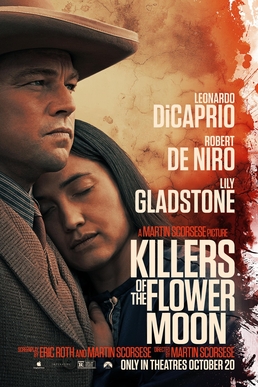
Movie Review: Killers of the Flower Moon, directed by Martin Scorsese (2023)
Martin Scorsese’s adaptation of David Grann’s gripping narrative, “Killers of the Flower Moon,” is nothing short of a cinematic triumph. The film navigates the intricate web of the Osage murders, unveiling a dark chapter in American history with precision and intensity.
Comparison with the Book:
Having read David Grann’s “Killers of the Flower Moon” when it first graced bookshelves in 2017, I found the cinematic adaptation by Martin Scorsese to be a remarkable journey back into the gripping narrative that had captivated me years earlier. I was initially drawn to the book after stumbling upon an NPR report that delved into the haunting tale of the Osage murders. The transition from page to screen is seamless, and Scorsese’s visual storytelling adds a layer of depth to Grann’s meticulous research. The film not only maintains the historical gravity of the book but also transforms it into a visceral and immersive experience. It’s a testament to the enduring power of Grann’s narrative and Scorsese’s ability to bring stories to life with cinematic brilliance.
While both the book and the movie share the core narrative, Scorsese’s visual storytelling adds a layer of depth to Grann’s meticulous research. The film captures the essence of the book, maintaining the historical gravity while transforming it into a visceral and immersive experience. The adaptation successfully retains the tension and intrigue, doing justice to Grann’s exploration of the Osage murders.
Leonardo DiCaprio and Robert De Niro:
The pairing of DiCaprio and De Niro in “Killers of the Flower Moon” marks a unique collaboration under the Scorsese banner. While not a trademark duo in Scorsese’s previous works, their joint presence in this film introduces a new dynamic that showcases the director’s ability to bring together two powerhouse actors for a captivating cinematic experience. DiCaprio, known for his electric performances, delivers yet another stellar portrayal, adding another memorable character to his collaboration with Scorsese. In “Killers of the Flower Moon,” he takes the role of Ernest Burkhart, demonstrating his versatility and commitment to character. From the high-energy charisma of “The Wolf of Wall Street” to the intense complexity of “The Departed,” DiCaprio consistently elevates his performances, leaving an indelible mark on each collaboration with Scorsese.
As for De Niro, his history with Scorsese is a cinematic treasure trove. From the raw intensity of “Raging Bull” to the crime saga of “Goodfellas,” and the poignant “Taxi Driver,” De Niro’s collaboration with Scorsese has been nothing short of legendary. In “Killers of the Flower Moon,” he takes on the role of William Hale, bringing his exceptional acting prowess to a character that adds depth and complexity to the narrative. The reunion of DiCaprio and De Niro in this film is a cinematic event, showcasing the chemistry and brilliance that only these two actors can bring, making “Killers of the Flower Moon” a unique chapter in Scorsese’s directorial legacy.
New Actress Wonder:
In the midst of the seasoned brilliance of DiCaprio and De Niro, “Killers of the Flower Moon” introduces a captivating revelation in the form of Lily Gladstone. As Mollie Burkhart, Gladstone delivers a performance that resonates with emotional depth and nuance, marking her as a new actress wonder to watch. Her portrayal adds a layer of authenticity to the narrative, capturing the essence of the character with a grace and subtlety that leaves a lasting impression. Gladstone’s emergence in the spotlight within the grandeur of Scorsese’s cinematic canvas showcases the director’s keen eye for talent and his ability to elevate newcomers into the realm of acting brilliance. Mollie Burkhart becomes a poignant and memorable character, largely due to Gladstone’s remarkable performance, establishing her as a rising star in the world of cinema.
Gladstone’s presence becomes especially poignant in the context of the larger narrative—the chilling account of the Osage murders, a dark chapter in American history that often remains obscured. “Killers of the Flower Moon” sheds light on the systematic killings of the Osage Nation, providing a cinematic canvas for the audience to grapple with the grim reality of Native American history and genocide in the USA. Gladstone’s portrayal, in this context, becomes a powerful and necessary contribution, adding depth to the exploration of historical injustices and bringing forth a nuanced understanding of the impact on indigenous communities. Her performance contributes to the film’s broader significance as a vehicle for acknowledging and reckoning with the painful history woven into the fabric of the nation.
Scorsese’s Cameo Tradition:
Scorsese’s penchant for cameos in his own films adds a delightful touch to “Killers of the Flower Moon.” From “The King of Comedy” to “Taxi Driver,” his appearances have become a charming Easter egg for fans. In this film, his cameo appearing at the very end seamlessly weaves into the narrative, a nod to his playful engagement with his own creations and a testament to his unique ability to seamlessly integrate himself into the fabric of the story.
Music and Dedication:
The dedication to Robbie Robertson, the genius behind The Band’s music, adds a poignant layer to the film. Robertson and Scorsese initiated their collaboration in 1978 with “The Last Waltz,” a groundbreaking concert film that captured The Band’s farewell performance. This partnership continued to flourish over the years, leaving an indelible mark on cinema. From the iconic score of “The King of Comedy” to the atmospheric melodies of “Casino” and various other collaborations, Robertson’s music has been an integral part of Scorsese’s storytelling. The music, composed by Robertson, enhances the emotional depth of the story, creating a hauntingly beautiful atmosphere. The dedication pays tribute to the collaborative spirit of filmmaking, acknowledging the role of music in elevating the cinematic experience, creating moments that transcend time and space.
Final Thoughts:
“Killers of the Flower Moon” is a testament to the enduring brilliance of Martin Scorsese. The lengthy runtime effortlessly flows, a testament to the captivating storytelling and powerhouse performances. The legendary scenes, like the ranch engulfed in flames, linger in the mind, showcasing Scorsese’s mastery in crafting indelible moments.
As the awards season approaches, the potential of “Killers of the Flower Moon” to secure accolades in various categories looms large. From the compelling performances of DiCaprio, De Niro, and the revelation that is Lily Gladstone to the seamless adaptation of David Grann’s book, the film exhibits the qualities that often resonate with the Academy. With Scorsese’s directorial finesse, the haunting score by Robbie Robertson, and the immersive cinematography, “Killers of the Flower Moon” has the makings of an award-season heavyweight, poised to make waves across multiple categories. It’s not just a celebration of arts; it’s a potential contender for cinematic glory on the grandest stage.
In fact, it wouldn’t be an overstatement to declare “Killers of the Flower Moon” as a strong contender for the BEST movie of the year. Its powerful narrative, coupled with exceptional performances and the exploration of a dark chapter in American history, elevates it to a level that transcends mere cinematic achievement. It becomes a cultural touchstone, inviting audiences to grapple with the complexities of the past while appreciating the artistry that brings it to life on the silver screen.
In the grand tapestry of Scorsese’s filmography, “Killers of the Flower Moon” stands tall as a testament to the enduring power of storytelling and the magic that happens when cinematic maestros unite. It’s a celebration of art, history, and the unyielding spirit of those who bring stories to life on the silver screen.
© Francesc Borrull, 2023
 Francesc Borrull