
By Francesc Borrull · February 26, 2024

1. Gustav Mahler: The Man Behind the Music
Gustav Mahler, a towering figure in late 19th and early 20th-century music, was a Bohemian-Austrian composer and conductor, born in the humble village of Kalischt, Bohemia (now Kaliště, Czech Republic) in 1860. His profound impact on the Romantic and early modernist periods is imprinted on the history of classical music. Mahler’s unique ability to synthesize orchestral forces and pioneer innovative structures set him apart in a musical landscape undergoing significant transformation.
My personal journey with Mahler commenced during my high school years, as narrated in this previous post. The discovery of Mahler’s compositions sparked an intense and passionate exploration, leading me to collect and immerse myself in his vast musical repertoire. Mahler’s music, for me, is not merely an auditory experience; it is a profound resonance that echoes through the chambers of the soul. It is a musical language that transcends time, providing a visceral connection to the human experience.
The resonance in Mahler’s music emanates from its ability to evoke a spectrum of emotions, from the deepest sorrows to the most triumphant joys. The intricacy of his orchestration, the poignant melodies, and the grandiose structures create an immersive sonic landscape that resonates with the complexities of life. It is a resonance that transcends the boundaries of mere appreciation, forging a deep and personal connection.
Simultaneously, there is a profound reverence that Mahler’s music commands. It is not just the act of listening; it is a ritualistic engagement with the sublime. The reverence emerges from the meticulous craftsmanship, the meticulous attention to detail, and the deep introspection embedded in each note. Mahler’s symphonies, including the monumental Symphony No. 5, are not just compositions; they are spiritual journeys that invite contemplation and reflection.
The profound resonance and reverence I feel for Mahler’s music are, in part, a result of its ability to serve as a companion through life’s myriad experiences. The music becomes a mirror, reflecting the highs and lows, the struggles and triumphs, resonating with the very fabric of existence. Additionally, the sheer audacity of Mahler’s ambition, his willingness to grapple with the existential questions of human existence, adds to the reverence. In Symphony No. 5, these qualities are particularly pronounced, making it a pinnacle of Mahler’s expression.
In conclusion, Mahler’s music is not just a collection of notes; it is an immersive journey into the depths of the human soul. Born from the Bohemian countryside, Mahler’s compositions carry the essence of his roots, resonating with universal themes that continue to captivate listeners across generations. As we delve into the specificities of Symphony No. 5, the resonance and reverence embedded in Mahler’s musical language will serve as our guiding lights.
2. Introduction to Mahler’s Symphony Work
Gustav Mahler’s symphonic legacy unfolds across ten monumental works, creating one of the most enduringly powerful symphony cycles in the history of music. Each symphony is a vibrant exploration of human emotion and the cosmic scope of existence, marked by iconic moments, fervently debated stories, and groundbreaking innovations in form, concept, and instrumentation. As we embark on this journey through Mahler’s symphonies, let’s take a brief look at each, offering a glimpse into the emotional richness and substance that defines this extraordinary body of work.
Symphony No. 1 (1888): Recognized as one of the all-time great first symphonies, Mahler’s Symphony No. 1 underwent a prolonged period of revision, transforming into its final form after an initially underwhelming premiere. Titled “Titan” at one point, the symphony introduces shimmering, pastoral awakening and energetic folk dance, leading to a controversial funeral march. Despite early challenges, it stands as a testament to Mahler’s exploration of mortality and contrasts.
Symphony No. 2 (1894): Contemplating life and death on a cosmic scale, Mahler’s Symphony No. 2 culminates in an ecstatic hymn of resurrection. Reverently referred to as “the death shriek,” this symphony weaves climactic reassurances and spiritual glory, captivating listeners with its emotional depth and uplifting grandeur.
Symphony No. 3 (1896): Holding the distinction of being one of the longest symphonies ever written by a major composer, Mahler’s Third features a gargantuan first movement followed by refreshingly distinctive shorter movements. The colossal work, with its profound impact on audiences, showcases Mahler’s mastery in creating musical landscapes of incredible breadth.
Symphony No. 4 (1901): From its sleigh-bell opening to a final movement depicting a child’s vision of heaven, Symphony No. 4 carries an air of innocence uncommon in Mahler’s works. Its relatively accessible nature, delicate orchestration, and idiosyncrasies, such as a scherzo with a solo violin tuned higher, contribute to its unique charm.
Symphony No. 5 (1902): The first purely orchestral symphony in Mahler’s trilogy, Symphony No. 5 represents a departure from explicit programmatic significance. Its famous Adagietto, a serene love letter to Mahler’s wife, Alma, adds to its allure. The symphony is punctuated by musical references, including the iconic four-note theme from Beethoven’s Fifth, showcasing Mahler’s intertextual mastery.
Symphony No. 6 (1904): Renowned for introducing the “Mahler hammer,” Symphony No. 6 features a literal and unforgettable use of a large hammer in the finale. Critics initially mocked Mahler’s audacious ideas, but the symphony’s captivating moments, including the hammer’s raised anticipation, contribute to its enduring impact.
Symphony No. 7 (1905): The most enigmatic and rarely performed of Mahler’s cycle, Symphony No. 7 is hailed by the composer himself as his finest work. Exploring nature, a many-layered nighttime, and a “bright day” finale, its emotional and thematic variety, especially in the middle three movements, adds to its remarkable allure.
Symphony No. 8 (1906): Nicknamed the “Symphony of a Thousand,” Mahler’s Eighth marks the return of choral music on a grand scale. Premiered during his lifetime, it became an immediate critical and popular success, solidifying its place as one of the largest productions in the symphonic repertoire.
Symphony No. 9 (1909): Described by conductor Franz Welser-Möst as “the strongest, most impactful farewell ever written in music,” Symphony No. 9 stands as Mahler’s final completed symphony. Its transcendent and emotionally arresting composition invites listeners to explore the nuances shaped by different conductors across iconic performances.
Symphony No. 10 (1910): Mahler completed only the first movement, the moving Adagio, of Symphony No. 10. While exceptional efforts have reconstructed the full symphony from Mahler’s drafts, the Adagio alone has enjoyed remarkable longevity as a haunting and fitting conclusion to Mahler’s exploration of life, death, and eternity.
This overview sets the stage for a deeper exploration of Symphony No. 5, a pivotal work in Mahler’s oeuvre, where the themes of resonance and reverence continue to echo through the composer’s intricate musical tapestry.
3. Mahler Symphony No. 5: A Deep Dive
3.1 Inception and Composition
Symphony No. 5, a monumental creation by Gustav Mahler, came to life between 1901 and 1902, marking a significant juncture in the composer’s illustrious career. Mahler embarked on this transformative musical odyssey during his tenure as the principal conductor of the Vienna Court Opera. It was in the idyllic surroundings of the Austrian countryside, specifically in the charming town of Maiernigg on the Wörthersee, that Mahler found solace and inspiration for this symphony.
The composition of Symphony No. 5 unfolded against a backdrop of personal turmoil and triumph. Mahler, known for infusing his compositions with the struggles and joys of his own life, was grappling with both professional and personal challenges. His tenure in Vienna was marked by political tensions and artistic clashes, providing a tumultuous backdrop to his creative process. Additionally, Mahler’s own health was a concern during this period, adding a layer of intensity to the emotional landscape of the symphony.
The symphony is often interpreted as a reflection of Mahler’s journey from despair to exultation, mirroring his own struggles and triumphs. The grandiosity of the composition, with its five movements, serves as a testament to Mahler’s resilience and artistic vision. Each movement unfolds as a chapter in Mahler’s introspective narrative, showcasing his mastery of orchestration and thematic development.
In the face of challenges, Mahler demonstrated his creative ingenuity. The symphony reveals his adeptness at seamlessly integrating diverse musical elements, from intricate counterpoint to sweeping melodic lines. The use of the symphonic form allowed Mahler to explore and resolve complex emotions, transforming personal turmoil into a symphonic masterpiece.
Symphony No. 5 stands not only as a musical triumph but also as a testament to Mahler’s ability to transcend adversity through his art. It is in understanding the context of its composition—the serene Austrian countryside, the tumultuous Viennese opera scene, Mahler’s health struggles, and his creative solutions—that we gain a deeper appreciation for the profound journey encapsulated in this symphonic masterpiece.
3.2 Movement Analysis
Movement I: Trauermarsch (Funeral March): The symphony opens with the solemn and tragic Trauermarsch, a Funeral March. This section delves into the commentary on the themes of death and rebirth, examining Mahler’s poignant expression and the intricate interplay of musical elements that set the tone for the entire composition.
Movement II: Stürmisch bewegt, mit größter Vehemenz (Stormy, moving with greatest vehemence): The second movement, Stürmisch bewegt, mit größter Vehemenz, is a turbulent and intense portrayal, reflecting Mahler’s emotional turmoil during the time of composition. This analysis explores the dynamics, emotions, and thematic development that make this movement a striking representation of Mahler’s inner struggles.
Movement III: Scherzo: Kräftig, nicht zu schnell (Scherzo: Powerful, not too fast): The lively and rhythmic third movement, Scherzo: Kräftig, nicht zu schnell, offers a contrast and a moment of relief within the symphony. This section provides commentary on the playful and energetic aspects of the movement, elucidating its role in the overall emotional narrative.
Movement IV: Adagietto: Sehr langsam (Adagietto: Very slow): The fourth movement, Adagietto: Sehr langsam, is arguably the most famous and poignant segment of the symphony. This deep analysis explores the nuances of this Adagietto, often considered a love letter from Mahler to his wife Alma. It examines its emotional depth, the delicate orchestration, and its profound impact on listeners.
Movement V: Rondo-Finale: Allegro – Allegro giocoso. Frisch (Rondo-Finale: Allegro – Allegro giocoso. Fresh): The final movement, Rondo-Finale: Allegro – Allegro giocoso. Frisch, concludes the symphony with triumphant exuberance. This section explores the dynamic and optimistic aspects of the finale, highlighting its role in resolving the emotional journey embarked upon in the preceding movements.
3.3 Best Recordings
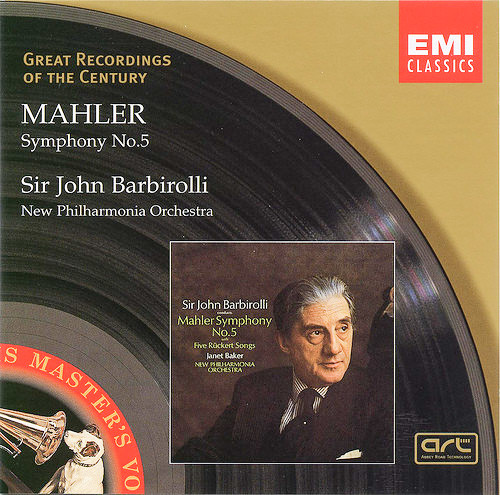
Sir John Barbirolli, New Philharmonia Orchestra – EMI, 1970
Sir John Barbirolli’s interpretation of Mahler’s Symphony No. 5 with the New Philharmonia Orchestra in 1970 is not only a historical gem but holds a special place as my personal favorite rendition of this symphony. In this landmark recording, Barbirolli brings a distinctive flavor to Mahler’s work, infusing it with emotional depth and a nuanced understanding of the composer’s intent.
Barbirolli’s rendition of Symphony No. 5 is characterized by its rich, warm textures and meticulous attention to detail. The Funeral March (Trauermarsch) is hauntingly evocative under his baton, capturing the somber essence of Mahler’s reflections on life and death. The second movement, Stürmisch bewegt, mit größter Vehemenz, is charged with intensity, reflecting the emotional turbulence that Mahler experienced during the composition.
One of the standout features of Barbirolli’s interpretation lies in his treatment of the Adagietto. In this famous movement, Barbirolli’s pacing and delicate phrasing create an atmosphere of profound intimacy. The Adagietto, often considered a love letter from Mahler to his wife Alma, unfolds with poignant tenderness, leaving an indelible mark on the listener.
Beyond the musical nuances, the historical significance of Barbirolli’s recording cannot be overstated. Coming at a time when Mahler’s works were gaining increased recognition, this interpretation contributed to the broader Mahler revival of the mid-20th century. Barbirolli’s commitment to Mahler’s emotional language and his ability to convey the depth of the composer’s inner struggles make this recording a valuable testament to the evolving interpretation of Mahler’s Symphony No. 5.
In essence, Sir John Barbirolli’s 1970 recording stands not just as a historical rendition but as a profound interpretation that captures the zeitgeist of its time while honoring Mahler’s timeless exploration of the human condition. As my personal favorite, it remains a cornerstone in the discography of Mahler’s Symphony No. 5, inviting listeners to traverse the emotional landscapes of Mahler’s world through Barbirolli’s insightful and historically resonant lens.
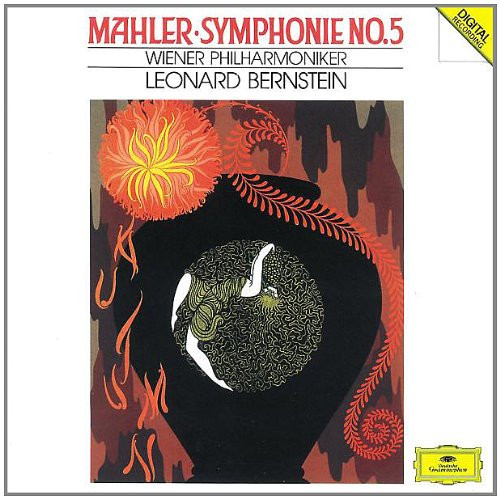
Leonard Bernstein, Vienna Philharmonic Orchestra – DG, 1988
Leonard Bernstein’s rendition of Mahler’s Symphony No. 5 with the Vienna Philharmonic Orchestra in 1988 is not just an analysis but an exploration of unparalleled emotional depth, often regarded by many as the definitive and best recording of this symphony.
In the opening Funeral March (Trauermarsch), Bernstein conducts with a poignant gravitas, skillfully navigating the solemnity of the movement. The strings, under his baton, convey a mournful elegance, evoking a sense of introspection and contemplation. Bernstein’s attention to dynamic contrasts within this movement adds layers of emotional complexity, setting the tone for the entire symphony.
The second movement, Stürmisch bewegt, mit größter Vehemenz, unfolds with a distinctive fervor under Bernstein’s direction. The conductor masterfully captures the stormy turbulence inherent in Mahler’s emotional landscape. The brass and woodwinds, in particular, shine in this interpretation, conveying a sense of urgency and emotional intensity.
Moving to the Adagietto, Bernstein’s approach showcases a delicate balance between restraint and emotional richness. The Vienna Philharmonic’s strings, guided by Bernstein’s nuanced interpretation, deliver the Adagietto as a poignant love letter. The conductor’s deliberate pacing allows the movement to breathe, emphasizing its intimate and expressive qualities.
As the symphony progresses into the Rondo-Finale: Allegro – Allegro giocoso. Frisch, Bernstein injects a vibrant energy into the finale. The exuberance of the Vienna Philharmonic under his baton brings forth a triumphant conclusion to Mahler’s emotional journey. Bernstein’s dynamic control in this section is particularly notable, creating a sense of resolution and optimism.
Beyond the technical aspects, Bernstein’s 1988 recording captures the essence of Mahler’s emotional spectrum. His interpretation is marked by a profound connection to the material, and his ability to draw out the subtleties in Mahler’s score is evident throughout. Widely acclaimed as the number one, best recording of Mahler’s Symphony No. 5, Leonard Bernstein’s 1988 rendition is not just a journey into the soul of the composition; it is a testament to the conductor’s unparalleled understanding of Mahler’s emotional language and his capacity to communicate that understanding to both the orchestra and the listener.
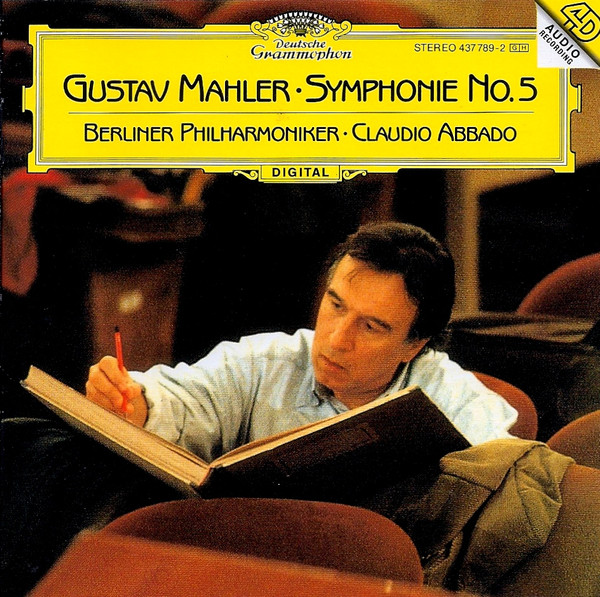
Claudio Abbado, Berliner Philharmoniker – DG, 1993
Claudio Abbado’s rendition of Mahler’s Symphony No. 5 with the Berliner Philharmoniker in 1993 is a masterclass in nuanced interpretation and technical brilliance. Widely esteemed for its unique qualities, this recording showcases Abbado’s meticulous attention to detail and his ability to extract the full emotional spectrum embedded in Mahler’s composition.
Abbado’s interpretation of the Funeral March (Trauermarsch) exhibits a refined sensitivity. The Berliner Philharmoniker, under his direction, navigates the mournful passages with precision, emphasizing the intricate layers of Mahler’s orchestration. The conductor’s subtle shaping of phrases adds depth to the solemnity, creating a compelling narrative that resonates throughout the movement.
In the second movement, Stürmisch bewegt, mit größter Vehemenz, Abbado captures the stormy intensity with a sophisticated touch. The Berliner Philharmoniker delivers a performance that balances urgency with clarity, allowing the emotional turbulence of Mahler’s vision to shine through. Abbado’s emphasis on precision in the ensemble brings a technical brilliance to this movement, enhancing its impact.
The Adagietto, often considered the heart of Mahler’s Symphony No. 5, is approached by Abbado with a delicate finesse. The Berliner Philharmoniker’s strings, guided by Abbado’s insightful interpretation, convey a sense of profound intimacy. The conductor’s ability to shape the dynamics and phrasing in this movement highlights the technical brilliance that defines this recording.
As the symphony concludes with the Rondo-Finale: Allegro – Allegro giocoso. Frisch, Abbado’s direction brings out the exuberance of the Berliner Philharmoniker, providing a fitting conclusion to Mahler’s journey. The technical precision of the orchestra, under Abbado’s guidance, contributes to the overall brilliance of this finale.
In summary, Claudio Abbado’s 1993 recording is a testament to his interpretive prowess and the technical excellence of the Berliner Philharmoniker. His nuanced approach reveals new facets of Mahler’s Symphony No. 5, making this recording a compelling choice for those seeking a profound and technically brilliant interpretation of this symphony.
4. Conclusion and Parting Thoughts
Allow me to share a personal reflection that intertwines with the timeless resonance of Gustav Mahler’s Symphony No. 5. As a teenager, navigating the corridors of my senior class in high school at the tender age of 16 or 17, I stumbled upon a musical revelation—an encounter that would open a Pandora’s box of profound artistic exploration.
It was during those formative years that the ethereal notes of Mahler’s Symphony No. 5 first graced my ears, casting a spell that transcended the bounds of time and space. Little did I know that this symphony would become a lifelong companion—a source of solace, inspiration, and intellectual curiosity. The richness of Mahler’s musical language spoke to me in a way that resonated far beyond the confines of my youth.
Reflecting on that pivotal moment, I am reminded of the transformative power of music. Mahler’s Symphony No. 5, with its intricate tapestry of emotions, became a guiding force, shaping my understanding of the profound connection between art and the human experience. The symphony’s movements, each a universe unto itself, served as a soundtrack to the various chapters of my life.
Now, revisiting this symphony in 2024, the echoes of that teenage revelation continue to reverberate. The passion ignited during those high school years has evolved into a lifelong devotion—a testament to the enduring impact of Mahler’s genius. As I explore the nuances of different recordings and engage in a deep analysis of this symphony, I am reminded that, much like a musical composition, life unfolds in movements, each offering a new perspective and layer of meaning.
In concluding this journey through Gustav Mahler’s Symphony No. 5 and its diverse interpretations, the resonance of that initial teenage encounter remains palpable. The symphony, with its capacity to evoke complex emotions and provoke intellectual inquiry, stands as a testament to the timeless power of music to shape and enrich our lives. It is through such personal connections that the true essence of Mahler’s music reveals itself—a force that transcends the boundaries of time and continues to resonate, echoing through the corridors of memory and the ongoing symphony of life.
Gustav Mahler’s Symphony No. 5 emerges not merely as a composition but as a profound journey through the kaleidoscope of human emotion, a testament to Mahler’s unrivaled artistic genius and unparalleled emotional depth. This symphony, situated within the broader tapestry of his symphonic output, encapsulates the very essence of Mahler’s musical language—a language that speaks volumes about the complexities of the human experience.
As we traverse the intricate landscapes of Symphony No. 5, guided by the batons of Sir John Barbirolli, Leonard Bernstein, and Claudio Abbado, we find ourselves immersed in distinct interpretations that unveil the multifaceted layers of Mahler’s vision. Barbirolli’s historical gem, Bernstein’s emotional odyssey, and Abbado’s nuanced brilliance each contribute a brushstroke to the masterpiece, leaving an indelible mark on Mahler’s legacy.
The selected recordings not only capture the spirit of Mahler’s Symphony No. 5 but also serve as windows into the evolving interpretations of this timeless work. Sir John Barbirolli’s 1970 rendition, a personal favorite, stands as a historical cornerstone, marking a pivotal moment in the mid-20th-century Mahler revival. Leonard Bernstein’s 1988 recording, widely acclaimed as the number one rendition, delves into the very soul of Mahler’s creation, offering an emotional journey that resonates profoundly. Claudio Abbado’s 1993 interpretation, a showcase of technical brilliance, adds a layer of refined sensitivity to the symphony, enriching the listening experience.
In the vast expanse of classical music, Mahler’s relevance endures, transcending temporal boundaries. His Symphony No. 5, with its intricate movements and emotional depth, continues to resonate with contemporary audiences, affirming Mahler’s enduring importance in the ever-evolving landscape of classical music. The symphony’s ability to evoke a myriad of emotions—from the solemn Funeral March to the triumphant Rondo-Finale—speaks to its timeless relevance, inviting listeners to explore and rediscover its resonating echoes, ensuring that Mahler’s legacy remains vibrant and impactful in the hearts of music enthusiasts across generations.
© Francesc Borrull, 2024
Note: This article is a continuation of a previous post where I delved into the discovery of Gustav Mahler and his Symphony No. 5. For insights into my journey and initial encounters with Mahler’s captivating world, you can refer to the preceding article here.
P.S. Here are the links to the three recordings discussed in this articles:
- Sir John Barbirolli, New Philharmonia Orchestra – EMI, 1970. Listen here.
- Leonard Bernstein, Vienna Philharmonic Orchestra – DG, 1988. Listen here.
- Claudio Abbado Berliner Philharmoniker – DG, 1993. Listen here.
Clicking on these links won’t generate any financial benefit for the author. Happy listening!
 Francesc Borrull