
By Francesc Borrull · June 10, 2024
Note to the Reader
In celebration of the Fourth of July, Independence Day, I am publishing a brief paper I wrote titled “Forging Progress: Assessing the USA’s Impact on International Affairs and the Global Stage.” I wrote this paper in response to discussions I often have when I visit my home country, where some folks challenge the position and influence of the USA on the global stage. I always welcome these discussions and aim to defend the positive role the United States has played in global affairs, especially since World War I. My intent in writing this paper was to articulate some of the thoughts, arguments, and claims I frequently use to defend America’s role in international affairs. While I acknowledge that nothing is black and white, I firmly believe that, when all factors are considered, the influence of the United States in advancing humankind has been overwhelmingly positive.
The paper is divided into seven parts, including an abstract, an introduction, and a conclusion. This is not an academic paper but rather a result of my personal reflections on the issue. No formal research was conducted in writing this paper. I published the first part of the paper last week, and today I am publishing the second part. The rest of the paper will be published according to the following schedule:
- June 17, 2024: 4) Contributions to Global Peace and Stability, and 5) Economic Prosperity and Innovation
- June 24, 2024: 6) Challenges and Self-Reflection, and 7) Alternative Systems
- July 1, 2024: 8) Conclusion
I hope you find this series thought-provoking and engaging. Thanks for reading!
2. Historical Contributions and Rebuilding Efforts
Introduction
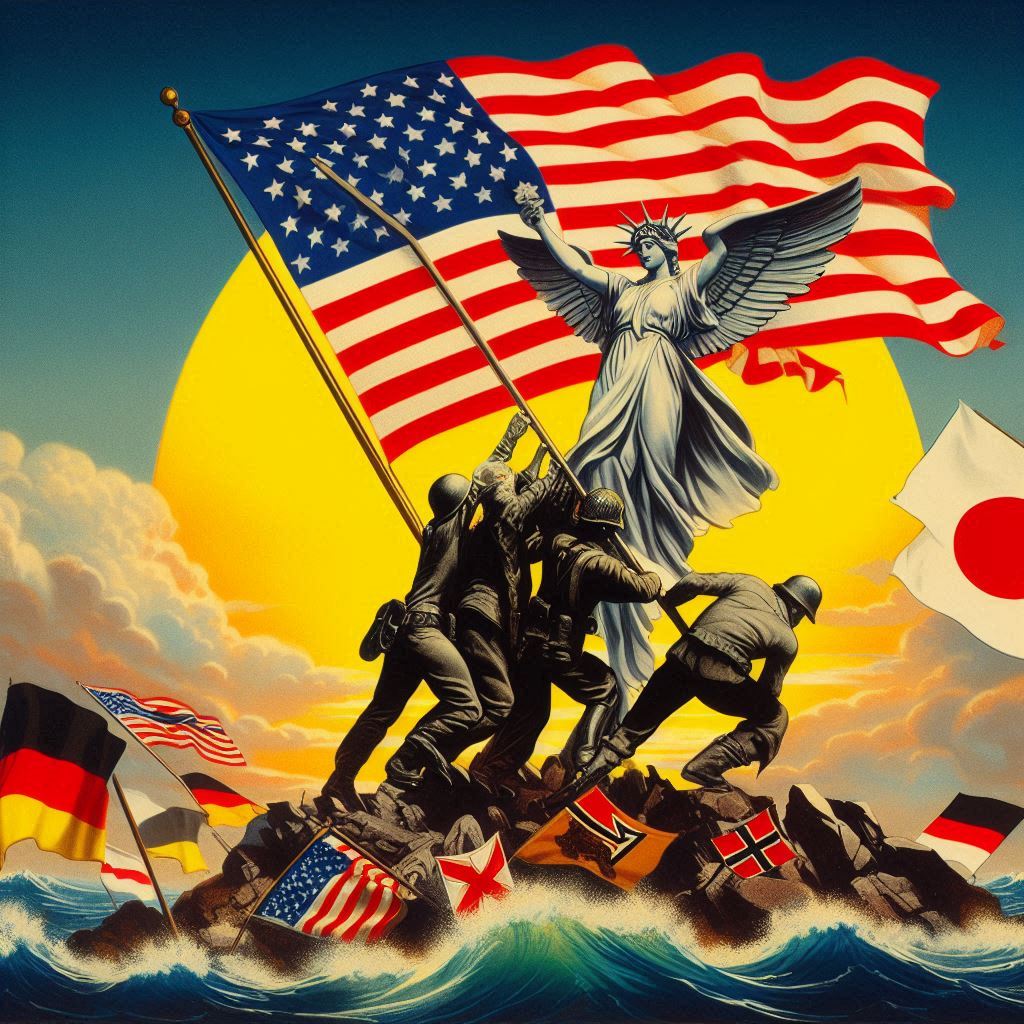
In the aftermath of World War II, the global landscape bore witness to a transformative era, marked by devastation and the arduous task of rebuilding. At the forefront of this monumental effort stood the United States, a nation that undertook a leading role in post-war reconstruction. This section delves into the historical contributions of the USA, with a specific focus on the Marshall Plan and the reconstruction of Japan. While acknowledging the positive impact on global stability and economic recovery, we will critically examine potential criticisms related to economic influence and power dynamics, aiming to present a nuanced perspective on the USA’s historical role in shaping the post-war world order.
Historical Contributions and Rebuilding Efforts
The Marshall Plan, initiated in 1948, remains a hallmark of the USA’s commitment to global recovery. This comprehensive aid program extended financial assistance to war-torn European nations, fostering economic rehabilitation and stability. The infusion of capital and resources not only revitalized shattered economies but also contributed to the establishment of democratic institutions, laying the foundation for lasting political stability in the region.
Simultaneously, the USA played a pivotal role in the reconstruction of Japan, which had been devastated by the war. The transformative process, guided by American assistance, led to the establishment of a democratic government and the emergence of a prosperous, pacifist Japan. The reconstruction efforts in both Europe and Japan were not mere acts of benevolence but strategic investments in global stability, recognizing the interconnectedness of nations in the post-war era.
Addressing Potential Criticisms
While acknowledging these achievements, it is essential to address potential criticisms related to economic influence and power dynamics. Some critics argue that the USA’s involvement in post-war reconstruction was driven by self-interest, leveraging economic aid to establish influence and secure geopolitical advantages. However, a closer examination reveals a more complex reality.
The Marshall Plan, for instance, was not solely a tool of economic dominance; it was a visionary initiative rooted in the belief that a stable and prosperous Europe would contribute to a more secure and interconnected world. The USA’s interest extended beyond narrow self-interest, encompassing a broader vision of global stability and the containment of communism during the Cold War.
In the case of Japan, while the reconstruction efforts undoubtedly benefited American interests, the broader objective was the creation of a democratic, peaceful ally in the strategically vital Pacific region. The success of these endeavors underscores a nuanced approach that recognizes both self-interest and the broader goal of fostering a stable international order.
In conclusion, the USA’s historical contributions to post-World War II reconstruction, particularly through the Marshall Plan and the rebuilding of Japan, reflect a multifaceted commitment to global stability. While acknowledging the positive impact on economic recovery, it is crucial to dismiss simplistic criticisms and recognize the strategic vision that underpinned these efforts. The next sections will further explore the USA’s role in defeating totalitarianism, contributing to global peace and stability, and the economic prosperity and innovation associated with its capitalist system.
3. Defeating Totalitarianism
Introduction
World War II, a global conflict of unprecedented scale, witnessed the emergence of the United States as a pivotal force against totalitarianism. This section delves into the critical role played by the USA in defeating formidable adversaries like Nazi Germany and Imperial Japan. Beyond the military victories, the USA’s efforts led to the liberation of oppressed nations and laid the groundwork for the establishment of democratic values. By examining this historical chapter, we aim to underscore the USA’s indispensable contribution to the triumph over totalitarian regimes and the promotion of democratic ideals on the global stage.
Defeating Totalitarianism
At the outset of World War II, the world faced the looming threat of totalitarian regimes that sought to impose their oppressive ideologies on sovereign nations. The USA, recognizing the urgency of the situation, emerged as a key player in the fight against tyranny. The commitment to the principles of democracy and individual freedoms became the driving force behind the American war effort.
The defeat of Nazi Germany stands as a testament to the resilience and determination of the Allied forces, with the USA playing a central role in coordinating military strategies and mobilizing resources. The Normandy landings in 1944, often referred to as D-Day, marked a turning point that paved the way for the liberation of Western Europe from Nazi occupation. The sacrifices made by American soldiers and their allies were instrumental in dismantling the oppressive regime that threatened the very foundations of democracy.
Simultaneously, in the Pacific theater, the USA confronted Imperial Japan, another totalitarian power with expansionist ambitions. The Pacific island-hopping campaign and the decisive battles, including Midway and Okinawa, showcased American resolve in the face of adversity. The dropping of atomic bombs on Hiroshima and Nagasaki, while controversial, brought about the end of the war and set the stage for Japan’s transition to a democratic nation under American guidance.
Liberation of Oppressed Nations
The defeat of totalitarian regimes under American leadership resulted in the liberation of nations that had long suffered under oppressive rule. The people of Europe, subjected to the horrors of Nazi occupation, experienced newfound freedom and the opportunity to rebuild their societies. In the Pacific, nations like the Philippines and Korea were liberated from Imperial Japanese control, paving the way for self-determination and independence.
Establishment of Democratic Values
Beyond the military victories, the USA played a crucial role in shaping the post-war world order by advocating for democratic values. The establishment of the United Nations, with active American participation, aimed to foster international cooperation and prevent future conflicts. The USA’s commitment to rebuilding war-torn nations with an emphasis on democratic governance laid the groundwork for the spread of democratic ideals across the globe.
In conclusion, the USA’s crucial role in defeating totalitarian regimes during World War II not only secured military victories but also laid the foundation for the liberation of oppressed nations and the establishment of democratic values. The sacrifices made by the American people and their allies underscore the enduring commitment to principles that transcend national borders, shaping a more just and democratic world order. The subsequent sections will further explore the USA’s contributions to global peace and stability and its economic prosperity and innovation.
© Francesc Borrull, 2023-2024
P.S. Continue reading part 3 here.
 Francesc Borrull