
By Francesc Borrull · January 13, 2025
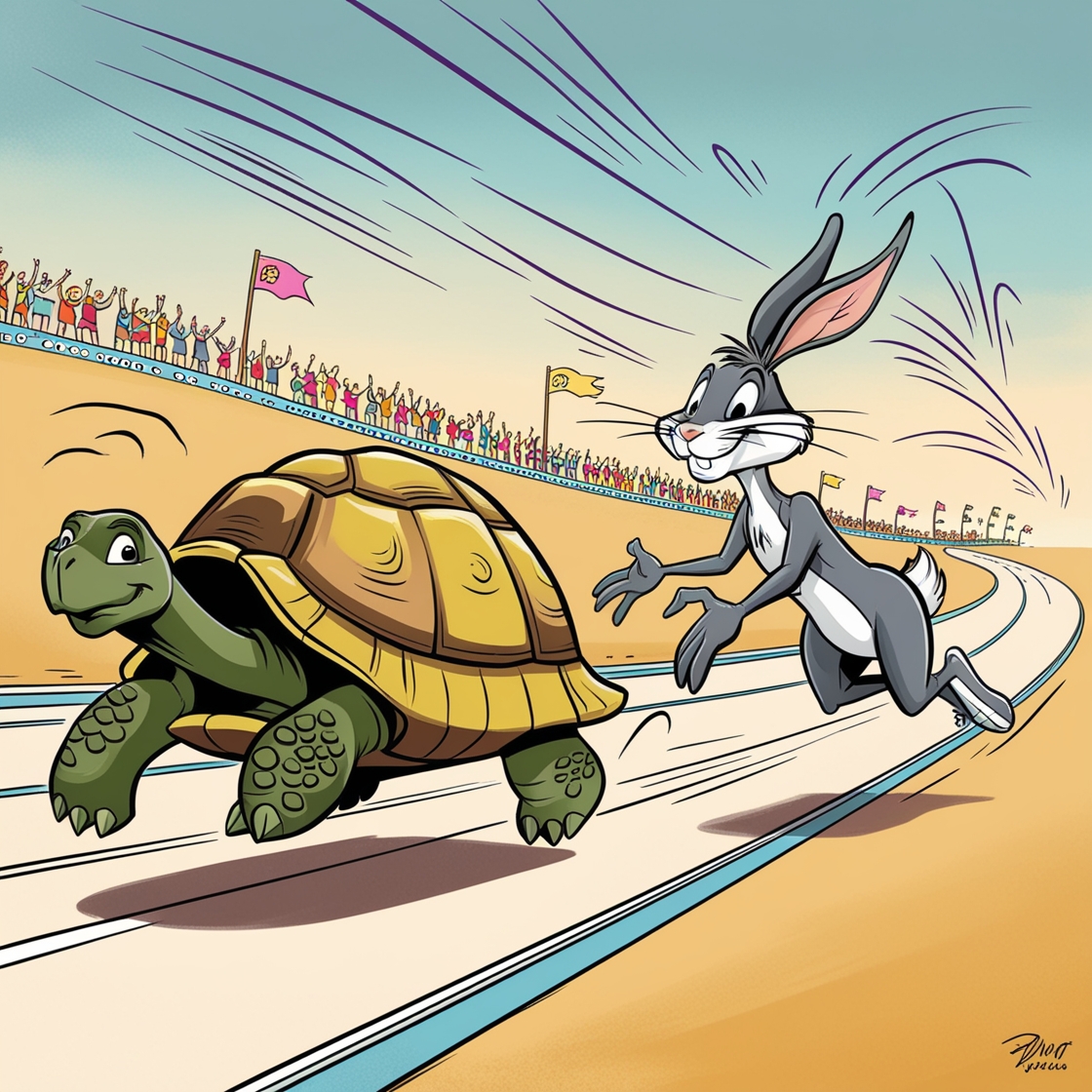
Have you ever stood on the sidelines of a marathon, watching runners stream by, and thought to yourself, “They don’t seem to be running that fast”? Yet, if you’ve ever been a runner in that same marathon, the experience is completely different. You feel the rush of wind, the power of your stride, and the sheer effort of propelling yourself forward—it feels like you’re flying. How can the same event feel so different depending on whether you’re watching or running? The answer lies in the fascinating world of physics and human perception.
Relative Motion: It’s All About Perspective
In physics, speed and velocity are not absolute values—they’re relative. The sensation of motion depends entirely on your frame of reference. As a spectator standing on the sidelines, you are stationary in relation to the environment around you: the road, the trees, the other fans. When you see runners pass by, their speed is measured relative to your stationary position. Because you’re not moving, your brain naturally compares the runners’ pace to the stillness of your surroundings. Even though they might be running at 12-15 km/h (or faster), their motion seems gradual, almost leisurely.
Contrast this with the perspective of a runner. When you’re running, your body becomes the reference point for everything around you. You’re aware of the ground rushing beneath your feet and the environment moving past you in a blur. Even if you’re running at the same 12-15 km/h, it feels much faster because everything you see is in motion relative to your body. This shift in perspective is a fundamental concept of relative motion—your frame of reference changes the way you perceive speed.
The Role of Environmental Cues
Another factor influencing your perception of speed is the presence of environmental cues. When you’re running, the objects around you—streetlights, trees, other runners, even the pavement—appear to zoom past. These rapidly changing visual cues provide your brain with a constant reminder of your movement. It’s similar to the sensation you feel when you look out the window of a moving car: the closer objects appear to move faster, enhancing your perception of speed.
As a spectator, however, the environment remains static. From your vantage point, the runners are the only things moving, and they’re doing so against a background that doesn’t change. This lack of dynamic visual input dampens your perception of their speed. Essentially, your brain interprets their movement as slower because there’s less contrast to highlight how fast they’re going.
Energy and Perception
The perception of speed is also tied to the physical effort involved. When you’re running, you feel every step. Your muscles are working, your heart is pounding, and you’re exerting significant energy to propel yourself forward. This physical effort creates a heightened awareness of your motion. Even at a moderate pace, the combination of exertion and sensory input—like the sound of your feet hitting the pavement and the rush of air against your face—makes you feel like you’re moving incredibly fast.
As a spectator, you’re not expending any effort, so the experience of speed is less visceral. You’re observing movement from a detached perspective, which makes it seem slower. Think of it like watching a video of a race versus participating in it—the former is purely observational, while the latter engages your entire body.
The Physics of Flying vs. Gliding
This phenomenon also ties into concepts like inertia and acceleration. When you’re stationary, as a spectator, you’re at rest relative to the runners. Your brain has to process their motion against your stillness, which diminishes the sensation of speed. As a runner, however, you’re part of the motion. Your body’s forward momentum creates an ongoing sensation of acceleration, even if your velocity is constant. It’s this active involvement in motion that makes running feel so much faster than it appears to an observer.
A Thought Experiment: The Treadmill Effect
Here’s a simple way to understand this difference. Imagine running on a treadmill at a steady 10 km/h. To you, it feels fast because you’re working hard, even though you’re not technically moving relative to the room. Now, imagine standing beside someone else running on that same treadmill. From your perspective, they don’t seem to be moving quickly at all. This discrepancy highlights how the experience of speed is deeply tied to both effort and relative motion.
The next time you’re at a marathon—whether you’re running or cheering from the sidelines—take a moment to think about how physics shapes your perception of speed. It’s a powerful reminder of how our experiences are shaped not just by what’s happening around us, but by where we stand and how we move through the world.
Walking El Camino de Santiago: A Lesson in Slow Speed
One of my most vivid personal experiences of speed and its perception came during my pilgrimage along El Camino de Santiago in northern Spain. Over the course of 30 days, I walked 500 miles, experiencing the world at a serene pace of about 4 miles per hour. For an entire month, my body and mind adapted to this slow rhythm of life.
When I finally reached Santiago de Compostela, a friend offered to drive me to Finisterre—the legendary “end of the Earth” as medieval Spain believed it to be. The drive took about an hour, with speeds varying between 40 and 60 miles per hour. To my surprise, I found the experience overwhelming. I got dizzy and felt almost terrified by the sheer velocity. After a month of moving through the world at walking pace, suddenly traveling 60 miles per hour felt like a whirlwind.
This contrast reminded me how our perception of speed is tied to what our body becomes accustomed to. Walking for 30 days had recalibrated my sense of motion. What had once felt normal now felt extreme.
I’ve noticed a similar phenomenon after being sick and spending several days resting in bed. When I finally get back behind the wheel of a car to drive, even at moderate speeds of 30 or 40 miles per hour, it feels too fast. My body needs time to readjust to the sensation of motion after being still for so long.
Training for Running Performance: An Eye-Opening Parallel
This idea isn’t limited to motion—it applies to training for running performance as well. For example, one runner’s “easy” pace might be 10 minutes per mile, while another’s might be 7 minutes per mile. Regardless of these differences, the goal of training is to increase speed while maintaining the same perceived effort. Over time, as fitness improves, paces increase. What once felt like a challenging pace becomes an easy one.
For instance, if my easy pace was once 10 minutes per mile and my high-intensity pace was 9 minutes per mile, consistent training might shift my easy pace to 9 minutes per mile. The fascinating part? It still feels easy. The body adapts, and what used to require significant effort becomes second nature. This transformation has been happening to me as a runner, and it never ceases to amaze me. Physics, physiology, and perseverance—it’s incredible how they work together to redefine our limits.
© Francesc Borrull, 2025
 Francesc Borrull