
By Francesc Borrull · February 10, 2025
When I moved to the U.S. in 2002, I made it my goal to read all the classic works of English literature (including American literature) in their original versions. I had read most of them in translation, either into Catalan or Spanish, but nothing compares to experiencing a book in its original language.
I probably started with Shakespeare, reading around 14 or 15 of his most well-known plays. My favorite? The Merchant of Venice. There’s something about Shylock’s monologue that has always resonated with me:
The great Al Pacino as Shylock, in The Merchant of Venice (2004), directed by Michael Radford.
But soon enough, I turned to the American classics. Among my favorite authors are John Steinbeck (The Grapes of Wrath), William Faulkner (anything he wrote is just pure brilliance!), and, above all, Mark Twain. Twain’s work captured my imagination so profoundly that I even visited his home in Hartford, Connecticut, while doing research at Yale for my PhD. Twain’s house is a stunning Gothic Revival home, now a museum, where he lived during some of his most prolific years, including the time he wrote The Adventures of Huckleberry Finn.

Speaking of Huckleberry Finn, it remains one of my top ten favorite books in the English language. However, in recent years, it has been at the center of controversy due to its language—specifically, the use of racial slurs. Some have even called for it to be banned. This, to me, is absurd. Literature should not be censored or erased; instead, it should be discussed and understood within its historical and cultural context. The novel is, at its core, a powerful critique of racism and hypocrisy in America. To judge it by a modern lens without acknowledging its deeper themes is to miss the point entirely.
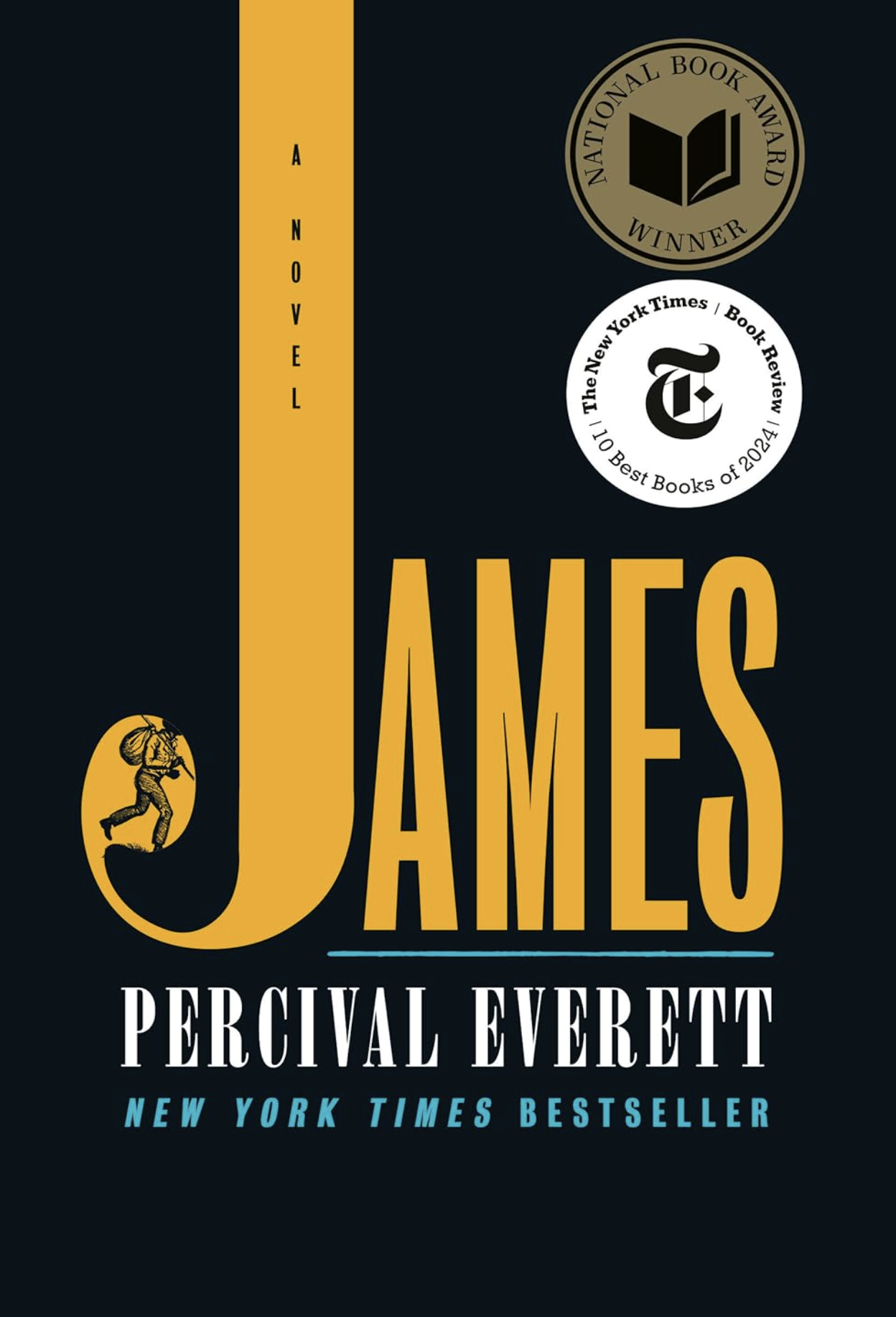
Fast forward more than twenty years, and here I am reading James by Percival Everett. It has been one of the most celebrated books of 2024, receiving widespread critical acclaim. The novel won the 2024 National Book Award for Fiction, the Kirkus Prize for Fiction, and the Carnegie Medal for Excellence in Fiction. Additionally, it was shortlisted for the Booker Prize and was named one of Time’s 10 Best Fiction Books of 2024.
I’ll admit, I don’t usually align with whatever is deemed “most popular.” I’ve read extensively—literature is my academic background, after all. I hold a master’s degree and a PhD in the field, and I’ve immersed myself in the Western literary canon. I approach popular books with an open mind, believing that you can learn from almost anything or anyone. However, I often find that the so-called “best books of the year” are overhyped, more a product of clever marketing than genuine literary merit. But this time, I was sold right away. It’s rare to find a contemporary novel this good.
James is brilliant. More than anything else, it does what great novels are meant to do—it tells a phenomenal story.
A Brief Summary of James
Percival Everett’s James is a powerful and imaginative retelling of The Adventures of Huckleberry Finn, but this time, the story is told through the eyes of Jim, the enslaved man who journeys with Huck down the Mississippi River. By shifting the perspective, Everett reclaims Jim’s voice, transforming him from a background character into the novel’s deeply complex and fully realized protagonist. Jim is no longer the passive, subservient figure from Twain’s original; instead, he is intelligent, resilient, and filled with his own hopes, fears, and agency. The novel explores not only Jim’s escape from slavery but also his interior life, his thoughts on freedom, and his sharp observations of the world around him. Everett masterfully balances humor, sorrow, and philosophical depth, creating a work that is both an homage and a bold reimagining of Twain’s classic.
How James Differs from Huckleberry Finn
One of the most striking differences between James and Huckleberry Finn is the narrative voice. Twain’s novel, while critical of slavery and racism, still portrays Jim through the lens of Huck’s limited understanding. In contrast, James allows Jim to tell his own story, giving him the intelligence, insight, and complexity that Twain’s version lacked. Everett’s Jim is literate, which completely alters the dynamic between him and Huck. Instead of being portrayed as naive, Jim is revealed to be strategic and self-aware, constantly weighing the dangers of his journey.
Another key difference lies in the novel’s treatment of language and race. Twain’s novel has long been controversial for its use of racial slurs, while Everett’s James directly engages with the power dynamics and dehumanization inherent in slavery. Everett doesn’t soften the brutality of the time period, but he does allow Jim to respond to it with both resilience and a biting wit.
Additionally, the novel expands on Jim’s relationships—not just with Huck, but with other enslaved people, abolitionists, and those who would see him captured. His quest for freedom is not just about escaping physical bondage but also about asserting his own identity and humanity in a world that seeks to deny him both.
The Literary Merits of James
What makes James such an outstanding novel is its brilliant combination of narrative craftsmanship, thematic depth, and linguistic precision. Everett’s prose is sharp and engaging, capturing both the beauty and brutality of Jim’s world. He weaves moments of humor and irony into even the most harrowing scenes, much like Twain did, but with an added layer of modern awareness.
Everett also employs masterful storytelling techniques, from shifting perspectives to unexpected plot twists, ensuring that the novel is both intellectually stimulating and emotionally gripping. His use of historical detail enriches the story without making it feel like a history lesson, and his dialogue is both authentic and deeply revealing of character dynamics.
The novel also serves as a meditation on storytelling itself—who gets to tell their story, how narratives shape our understanding of history, and the power of reclaiming lost voices. Everett doesn’t merely rewrite Huckleberry Finn; he transforms it into something new, urgent, and deeply relevant to contemporary discussions on race, identity, and literature.
Conclusion: Why James is a Must-Read
James is a novel that not only reimagines a classic but also stands firmly on its own as a literary masterpiece. Everett manages to honor Twain’s legacy while crafting something entirely new and necessary. It’s a novel about voice, about reclaiming agency, and about the power of storytelling itself.
I had an incredible time reading this book, and I wholeheartedly recommend it to anyone who loves literature, history, or simply a great story well told. If you haven’t picked it up yet, do yourself a favor and read it.
© Francesc Borrull, 2025
 Francesc Borrull