
By Francesc Borrull · July 28, 2025
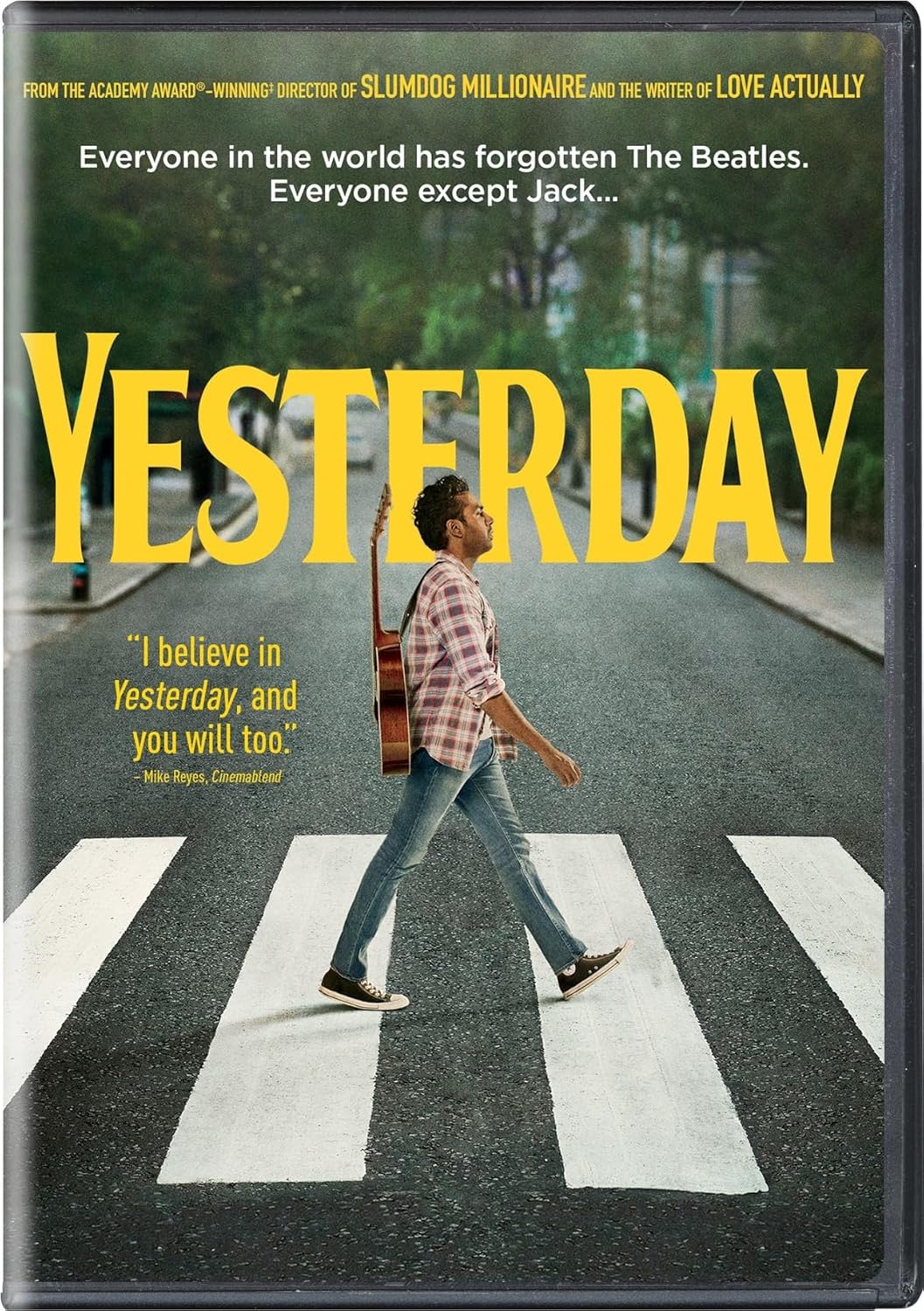
The other day, I stumbled upon a DVD at my local public library with a cover that instantly caught my eye: a man crossing a crosswalk, acoustic guitar slung across his back. The image was a clear nod to Abbey Road, and the title of the film was Yesterday. That was all I needed to see. I grabbed it immediately.
To my surprise, I had never even heard of this movie before — which is wild considering my deep affection for The Beatles, and the fact that the director is Danny Boyle (Slumdog Millionaire) and the writer is Richard Curtis (Love Actually), two filmmakers I greatly admire (especially Curtis — I have a soft spot for romantic British dramedies). So I popped the DVD into the player that evening, and from the first few scenes, I was hooked.
The Plot of Yesterday (At Least What I Could Watch!)
The story follows Jack Malik, played by the incredibly talented Himesh Patel, whom I had never seen before but instantly liked. Jack is a struggling musician in Suffolk, England. He works a mundane warehouse job, plays his original songs to small, indifferent crowds, and is just about ready to give up on music altogether. His manager and longtime friend (and possibly something more?) Ellie books him for a “big gig,” which turns out to be a poorly attended kids’ tent at a music festival. Defeated, he calls it quits.
But then, fate — or something stranger — intervenes.
During a mysterious global blackout, Jack is hit by a bus while riding home on his bicycle. He wakes up in the hospital battered but alive, and soon discovers that the world has changed: nobody remembers The Beatles. Not just vaguely — they simply never existed in this alternate timeline.
After receiving a beautiful new guitar as a get-well gift from Ellie, Jack strums the opening chords of Yesterday, and his friends are stunned. “That’s beautiful,” they say, genuinely impressed. Jack is confused. “It’s not mine,” he replies. “It’s Paul McCartney… The Beatles?” Blank stares.
A few internet searches confirm it: there are no Beatles. No Sgt. Pepper, no Abbey Road, no Oasis, even (Wonderwall is gone!). But Jack remembers. And he sets off on a mission to “recreate” the entire Beatles discography from memory.
Soon, his versions of these classic songs begin to gain traction. He plays them live, people listen, and the world falls in love with this “new” music. Eventually, a record producer offers him a deal. He becomes famous. And then — Ed Sheeran calls. For real.
And then — just as things were getting really exciting — the DVD froze at minute 34. Completely scratched. I cleaned it, blew on it, begged it to cooperate — but nothing worked. I couldn’t finish the film. Absolutely brutal. It was cinematic coitus interruptus. I have to buy it now.
From Fiction to Vinyl: A Journey Back to Rubber Soul
Heartbroken by the sudden pause in my movie night, I did the next best thing — I went straight to my vinyl collection and pulled out Rubber Soul. The last Beatles song I heard in the film before it cut off was In My Life, and that was it. That was the spark. I placed the needle on the record and sat back as those warm analog tones filled the room.
It was bliss. And it hit me like a revelation I’d known all along: Rubber Soul is my favorite Beatles album. Not Sgt. Pepper, not Abbey Road, not even The White Album. It’s Rubber Soul. And so this blog post, which started out as a tribute to Yesterday, has now become a love letter to Rubber Soul.
Rubber Soul: A Turning Point in Music History
Rubber Soul was released on December 3, 1965, recorded at EMI Studios (now Abbey Road Studios) over a period of just over four weeks. It marked a creative shift for The Beatles. No longer content with the upbeat, love-driven pop of their early years, the band began to explore more introspective lyrics, experimental sounds, and deeper themes — all without losing their signature melodic brilliance.
This album came after Help! and before Revolver. It was, in many ways, the beginning of the Beatles’ more “mature” period. Their folk-rock influences (particularly Dylan and The Byrds) shine through, but it’s also where their individual voices begin to truly diverge. You can hear Lennon, McCartney, Harrison — even Ringo — stepping into their own as artists.
Track-by-Track: Rubber Soul
Let’s go track by track, and celebrate this masterpiece in full.
1. Drive My Car
Written by: Lennon/McCartney
Sung by: Paul (main), with harmonies by John
A funky, Motown-inspired opener. Paul’s bassline is killer here, and the lyrics — cheeky and playful — play with gender roles. A woman wants to be famous and offers the man a job as her driver. A classic role-reversal that still grooves hard today.
2. Norwegian Wood (This Bird Has Flown)
Written by: Lennon/McCartney
Sung by: John
This is a game-changer. It’s one of the first pop songs to incorporate a sitar, played by George Harrison. The lyrics are subtly biting — Lennon tells a story of a romantic fling gone awkwardly cold.
NOTE: I must mention that this song inspired Haruki Murakami’s haunting novel Norwegian Wood, which also became a beautiful (and tragic) Japanese film. You can read my post on that here.
3. You Won’t See Me
Written by: Lennon/McCartney
Sung by: Paul
A classic Paul breakup song, with layered harmonies and a hint of bitterness beneath the bounce. It’s a masterclass in passive-aggressive pop, showing his growing lyrical depth.
4. Nowhere Man
Written by: Lennon
Sung by: John
One of Lennon’s earliest introspective songs, and possibly his first “non-love” lyric. It captures existential disillusionment beautifully. A philosophical gem.
5. Think for Yourself
Written by: George Harrison
Sung by: George
George is finding his voice here — literally and thematically. This is a biting takedown of groupthink and manipulation. Also notable for its fuzz bass, giving it a raw, edgy feel.
6. The Word
Written by: Lennon/McCartney
Sung by: John (lead), Paul (harmonies)
A proto-psychedelic anthem about love as a universal truth. The groove is infectious, and it foreshadows the hippie ethos that would later dominate Sgt. Pepper.
7. Michelle
Written by: Lennon/McCartney
Sung by: Paul
A delicate, French-inflected ballad that won the Grammy for Song of the Year in 1967. Paul’s pseudo-French crooning and the melodic structure make it irresistibly charming.
8. What Goes On
Written by: Lennon/McCartney/Starkey
Sung by: Ringo
The lone Ringo song on the album. It’s not groundbreaking, but it’s fun — a country-flavored tune that adds variety. Bonus: Ringo gets his first (and only) writing credit on a Beatles song here.
9. Girl
Written by: Lennon/McCartney
Sung by: John
Maybe my least favorite on the album. John sounds kind of whiny, though the instrumentation is lovely. It has moments, but compared to the others? Meh.
10. I’m Looking Through You
Written by: Lennon/McCartney
Sung by: Paul
A breakup song about betrayal and disillusionment. The lyrics are biting, and the arrangement keeps shifting in interesting ways. Paul is angry, and it works.
11. In My Life
Written by: Lennon/McCartney
Sung by: John
This one is sacred. Possibly my favorite Beatles song of all time. Nostalgic, reflective, honest. George Martin’s harpsichord-style piano solo elevates it to a transcendent level.
12. Wait
Written by: Lennon/McCartney
Sung by: John and Paul
Originally recorded during Help! and repurposed here, it’s a solid but not standout track. Still, it adds texture and variety to the album.
13. If I Needed Someone
Written by: George Harrison
Sung by: George
Clearly influenced by The Byrds, especially in the jangly guitar tone. It’s one of George’s strongest early contributions, and a sign of the songwriter he was becoming.
14. Run for Your Life
Written by: Lennon/McCartney
Sung by: John
The closer is… problematic. John himself later dismissed the lyrics (“I’d rather see you dead…”). Still, musically it’s got energy, but it’s not how I would have ended the album.
Final Thoughts: Art, Memory, and Why Rubber Soul Matters
As the movie Yesterday posits: what would a world without The Beatles even be? For those of us who’ve had their music stitched into the fabric of our lives, the thought is terrifying. Their songs are more than just tunes; they’re emotional signposts. They guide, comfort, challenge, and inspire us.
Rubber Soul is, in my opinion, the first truly great Beatles album. It’s cohesive, daring, and deeply human. It was the bridge between pop stardom and artistic revolution. And for me — as a listener, a music lover, a vinyl collector, and someone who finds meaning in melody — it is their absolute best.
Even though I didn’t get to finish Yesterday (yet!), the premise stayed with me. It reminded me that music is not just sound — it’s memory, identity, and emotion. Films like Yesterday help us reimagine the world and see the art we love through fresh eyes.
In the end, art — whether in song, story, or cinema — makes life richer. It builds bridges between hearts. It lets us travel across time and place. And sometimes, it sends us rushing to our record players to rediscover an album we’ve loved all along.
© Francesc Borrull, 2025
 Francesc Borrull