
By Francesc Borrull · April 20, 2026
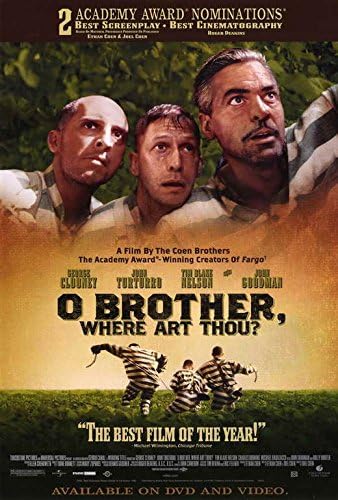
At the beginning of O Brother, Where Art Thou?, before the narrative even takes visual form, a voice from antiquity is invoked. On screen appear the opening lines of The Odyssey:
“O Muse!
Sing in me, and through me tell the story
Of that man skilled in all the ways of contending,
A wanderer, harried for years on end…”
Only after this invocation does the film descend into its first image: a chain gang in the Mississippi heat, men in shackles singing as they labor. The juxtaposition is immediate and deliberate. The ancient call to epic song is answered not by gods or kings, but by imprisoned men in the American South. Moments later, as the soundtrack shifts and the protagonists flee across open fields, another line appears: “Based upon ‘The Odyssey’ by Homer.” By then, the claim no longer introduces the film—it confirms what has already begun. The epic has not been referenced. It has already been translated.
The Coen brothers are not adapting The Odyssey. They are demonstrating something far more profound: that The Odyssey is not a story tied to a time and place, but a structure capable of surviving radical translation. What they offer is not homage, but proof. The epic persists—not as text, but as form.
This essay begins from that premise: that the “Odyssean” is not Greek, but human. It is a grammar of experience—a cognitive category through which survival, identity, and return are articulated across cultures. In O Brother, Where Art Thou?, the Mediterranean becomes the American South; maritime perils become social and political hazards; divine intervention becomes institutional power. The result is not a reinterpretation of Homer, but a reactivation of the epic under entirely different historical conditions.
I. The Illusion of Distance
At first glance, the distance between Homer and the Coens appears absolute. One is oral epic; the other, cinematic pastiche. One unfolds in hexameter; the other in bluegrass. One is structured by gods; the other by governors and sheriffs. But this distance is precisely the illusion the film dismantles.
The narrative skeleton remains intact. Everett McGill moves through a series of episodic encounters that mirror, not literally but structurally, the trials of Odysseus. The Sirens appear as river women washing clothes, their song transposed into sensual harmony. The Cyclops emerges as a one-eyed Bible salesman, grotesque and violent. The underworld becomes a Ku Klux Klan rally—ritualized, infernal, and collective. Penelope survives as Penny, skeptical and distant, demanding proof of legitimacy before accepting his return.
These are not clever references. They are functional equivalences. The Coens are not translating content; they are translating effects. This is not formal equivalence (word-for-word), but what translation theory would call dynamic equivalence: the recreation of meaning through analogous structures in a different system.

II. Oral Tradition and the Radio: Modern Kleos
In Homer’s world, The Odyssey exists as performance. The bard sings; the audience listens; the hero’s identity is constructed through repetition and memory. The Greek concept of kleos—glory, renown—is inseparable from this oral circulation. A man becomes what is said about him. In O Brother, Where Art Thou?, this mechanism reappears in technological form: the radio.
The Soggy Bottom Boys achieve fame not through heroic deeds, but through recording. Their song—“Man of Constant Sorrow”—circulates across the South before they themselves arrive. Like Odysseus, they are preceded by their story. Their identity is mediated, constructed externally, stabilized through repetition. The transformation is exact: oral epic → recorded sound; bard → broadcaster; kleos → mass media.
What the film reveals is that the medium has changed, but the function has not. The hero still depends on narrative circulation to exist.
III. Nostos and the End of the Mythic World
If The Odyssey is structured around nostos—the return home—then the Coens introduce a crucial complication: what if home itself is unstable?
The Mississippi of the 1930s is not static. It is being transformed by modernity: electrification, political machinery, economic restructuring. The film repeatedly contrasts two worlds: the “old, weird America” of blind prophets, wandering musicians, and mythic encounters, and the emerging bureaucratic order of governors, campaigns, and infrastructure.
The flood that concludes the film is not merely a plot device. It is a symbolic erasure. The valley—site of wandering, danger, and narrative—is submerged. The mythic landscape disappears beneath modernity.
Everett’s journey, then, is not simply a return. It is a passage through a world that is vanishing even as he moves through it. The Odyssey becomes, in this context, not just a story of return, but a story of loss—the disappearance of the conditions that made the journey possible.
IV. The Hero of Words: Metis as Performance
Odysseus is defined not by strength, but by metis: cunning, adaptability, intelligence in motion. Everett inherits this trait, but in translated form. His weapon is not strategy in battle, but language.
He speaks in elevated, pseudo-intellectual diction—“I am a man of large appetite,” “bona fide,” “Dapper Dan man”—a linguistic register entirely out of place in his environment. This is not accidental. It is functional.
In Homeric poetry, as Milman Parry and Albert Lord demonstrated in their groundbreaking work on oral tradition, the bard relies on formulaic expressions—“rosy-fingered Dawn,” “swift-footed Achilles”—to compose in real time. These formulas are not ornamental; they are structural. They stabilize the narrative.
Everett’s speech functions in the same way. His vocabulary is repetitive, rhythmic, identity defining. It creates distance between who he is (a convict) and who he performs himself to be (a man of intellect and authority). His language is his formula—his metrical constraint, his anchor.
The recurring phrase “bona fide” operates exactly like a Homeric epithet. It marks legitimacy. Without it, a man is nothing—socially invisible, the modern equivalent of Odysseus’s Outis (“No-Man”)—his name of negation before the Cyclops. In a more literal sense, this invisibility carries legal weight. In the bureaucratic world of the 1930s South, a man without standing—without papers, without recognition—is effectively non-existent, much like the exile in the Greek polis. Everett’s “bona fide” thus becomes not merely social validation, but a condition of existence.
To speak is to exist. To speak well is to command reality.
V. Divine Intervention and Secular Fate
In Homer, the gods intervene constantly. Athena guides; Poseidon obstructs; Zeus arbitrates. Fate (moira) is divine, but not always transparent. In the Coens’ world, the gods have been replaced: the Governor, the Law, the KKK, the machinery of politics. These institutions exercise power that is no less arbitrary, no less opaque than that of the Olympians. The Klan rally, in particular, functions as a dark parody of divine ritual—masked, choreographed, terrifying in its collective force.
And yet, the film introduces a counterpoint: the blind prophet at the beginning. Like Tiresias, he sees what others cannot. He foretells the journey in symbolic terms, suggesting that beneath the apparent secular order, something like fate persists. The result is a hybrid system: a world governed by institutions, yet haunted by forces beyond them.
There is, however, a crucial difference. Homer’s gods act according to personal motives—favor, resentment, pride. The Coens’ gods, by contrast, operate through institutions. Their decisions are shaped not by passion, but by optics, bureaucracy, and the logic of power. The arbitrariness remains, but its source has shifted: from divine personality to systemic indifference.
VI. Music as Epic Memory
Though not the central focus of this essay, the role of music cannot be ignored. In Homer, the epic begins with an invocation—“Sing, Muse”—establishing both the hero and the narrative that will carry his name. In the film, a similar function is performed by song. “I Am a Man of Constant Sorrow” operates as a modern proem: a formal declaration of identity that precedes the hero himself.
Like the Homeric invocation, it constructs kleos through repetition. The song travels across the South before the men do, ensuring that their story is known before their arrival. In this sense, it functions as a technological extension of oral tradition—a recorded voice replacing the bard.
The phrase “man of constant sorrow” itself takes on the quality of an epithet. Like “resourceful Odysseus,” it fixes the hero’s essence in a form that can be recognized, repeated, and remembered.
If Homer’s epic is sustained by voice, the Coens’ epic is sustained by song. Different medium—same necessity.
VII. Conclusion: The Epic as Grammar
What O Brother, Where Art Thou? ultimately demonstrates is that _The Odyssey _is not bound to its original language, geography, or historical moment. It is not even bound to literature. It is a structure of experience.
A man leaves home. He wanders through a world of danger, deception, and transformation. He survives through intelligence rather than force. He returns—not unchanged, but recognizable—seeking reintegration into a community that has moved on without him.
This is not Greek. It is human.
The Coen brothers, in translating Homer into Mississippi, reveal that the epic is not a relic, but a living form. _The Odyssey _persists not because it is preserved, but because it is reconstructed—again and again, in new languages, new media, new worlds.
We do not merely read Homer. We recognize him.
© Francesc Borrull, 2026
P.S. Reference Note: On oral-formulaic composition, see Milman Parry’s foundational studies on Homeric diction and Albert B. Lord’s The Singer of Tales (Cambridge, MA: Harvard University Press, 1960), which established that epic poetry in oral traditions is composed in performance through formulaic structures rather than memorized as fixed texts.

