
By Francesc Borrull · July 27, 2026
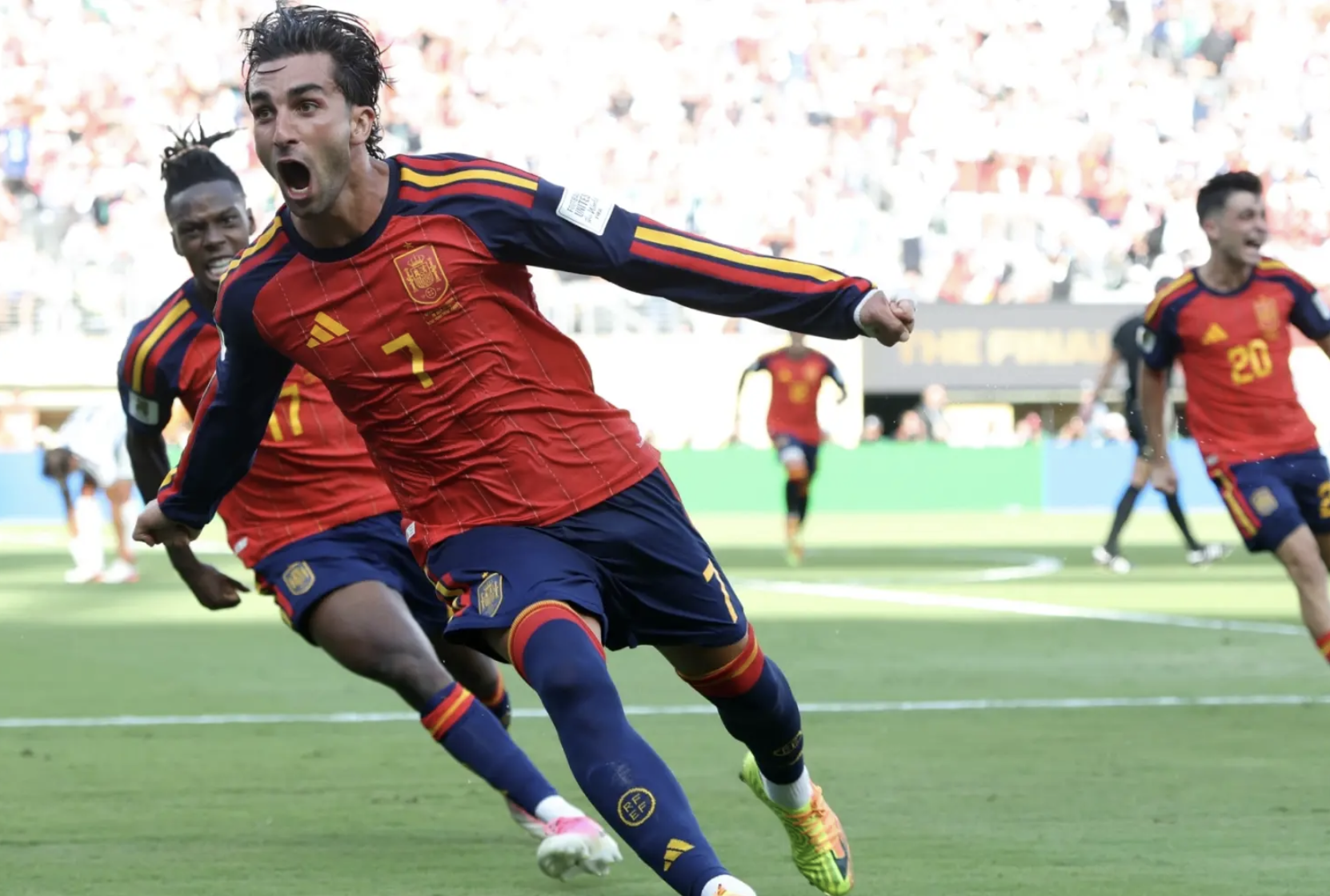
When Ferran Torres scored in the 106th minute of the 2026 World Cup final, the ball did something it has been doing to me for almost half a century: it opened a door in time. Spain were playing Argentina in New York New Jersey, and one clean finish in extra time was enough to make Spain world champions for the second time. Yet before the final whistle had finished echoing, I was no longer only in 2026. I was a child again, watching Mario Kempes in 1978, his hair flying, Argentina and the Netherlands stretching a final into extra time. Kempes scored twice that day. Argentina won 3–1. I remember the match with the unreasonable clarity of childhood, when the world arrives as image and emotion before it arrives as history.
The map of my life in football can almost be drawn as a triangle. Argentina defeated the Netherlands in the first World Cup final I remember, in 1978. Spain defeated the Netherlands in 2010, when Andrés Iniesta gave Spain its first World Cup. Then Spain defeated Argentina in 2026, when a new generation completed the shape. I do not mean that history is mystical or that results are destiny. Football is too full of deflections, tired legs, bad decisions, and sudden weather for that. I mean only that the game keeps returning us to earlier versions of ourselves. The child sees Kempes. The adult sees Ferran Torres. Between them stand Naranjito, Maradona, Cruyff, Koeman, Guardiola, Messi, entire generations of Spanish players, and an institution called FIFA that has repeatedly mistaken its power over a tournament for ownership of the game.
This essay is about both things at once: the glory of football and the people who try to exploit it. I cannot separate them completely, because adulthood has taught me what childhood did not know. But I refuse to confuse them. FIFA is not football. A federation is not the ball, a committee is not a team, and a president—however grand his stage or close his relationship with political power—is not the game. Football belongs first to the people who play it, teach it, argue about it, collect it, lose with it, and pass their love for it from one generation to another.
A Religion with Two Names
I love football. In Spain we call it fútbol. In the United States it is usually called soccer, a word Americans are often teased for using even though the British invented it. In nineteenth-century England, “association football” distinguished the game from rugby football; university slang shortened “association” to “soccer.” The word crossed the Atlantic and stayed, while Britain largely returned to football. Two names, then, but the same rolling ball—and a small reminder that the history of the sport is rarely as simple as the rivalries we build around it.
People say that fútbol is a religion in Spain, and I mostly agree. You are born into a household that is already attached to a team—or, as in my case, two. The inheritance arrives before the argument. A child learns the colors, the songs, the enemies, the legendary names, the painful defeats that the adults still discuss as though the referee might reverse them if the case were presented one more time. Stadiums have their pilgrimages. Matchdays have their rituals. Players become saints, heretics, prodigal sons. The faith can divide a dining table and unite a city. It teaches geography through away fixtures and family history through old lineups.
Yet the comparison has limits, and those limits matter. Football is not sacred because an institution declares it so. Its meaning is made collectively and repeatedly, on dirt lots, in schoolyards, on neighborhood pitches, in enormous stadiums, and in living rooms where everyone leans toward the screen at the same instant. The game offers a form of communion because millions can experience suspense together without knowing one another. That enormous reservoir of feeling is precisely why football attracts commerce, nationalism, political theater, and corruption. Power always wants to stand near devotion. It wants to borrow the crowd’s emotion and present it as its own.
David Goldblatt’s monumental book The Ball Is Round: A Global History of Soccer explains how the game acquired that reach. He begins before the modern sport, with older and often unruly ball games, then follows football’s codification in nineteenth-century Britain and its movement along the routes of empire, industry, ports, railways, schools, factories, and migration. The rules traveled with British merchants, sailors, teachers, and engineers, but the sport did not remain British. Communities everywhere remade it in their own image. Clubs became expressions of neighborhood, class, ethnicity, religion, political resistance, civic ambition, and national identity.
The spoiler, if a thousand-page history can have one, is that football never exists outside the world that produces it. Goldblatt moves through wars, dictatorships, decolonization, labor movements, television, sponsorship, stadium disasters, celebrity, and the immense transfer of money around the modern game. Football can provide solidarity to people ignored by official power; it can also be used by power as decoration. It can resist nationalism in one place and intensify it in another. The ball is round because it moves unpredictably, but the institutions around it leave fingerprints. Goldblatt’s great achievement is to show that football became a global language without becoming a single culture. We share the rules. We do not always share what the game means.
The World Came Home
My first recollection of a World Cup is the final in Buenos Aires on June 25, 1978. Argentina and the Netherlands were level after ninety minutes. Kempes, who had already scored the opening goal, struck again in extra time; Daniel Bertoni added another. Argentina were champions in their own country, Kempes was the tournament’s leading scorer, and to the child watching, the entire scene seemed made of noise, speed, blue-and-white paper, and celebration.
What I did not know was that Argentina was governed by a brutal military dictatorship. The junta kidnapped, tortured, and killed its opponents during the Dirty War. The ESMA detention and torture center stood less than a mile from the Monumental stadium where the final was played. While television cameras carried a national celebration around the world, families were searching for the disappeared. The regime understood the political usefulness of a victorious World Cup. It wanted the images of packed stands to crowd out the evidence of terror.
Learning that truth later did not erase my memory; it changed its depth. The child was not responsible for what he could not see. But the adult cannot pretend the unseen did not exist. This is one of football’s permanent moral pressures. The match is real. The players’ effort is real. The crowd’s joy is real. The suffering beyond the camera frame is also real. To love the game honestly is not to flatten one reality into the other. It is to hold them together, even when they do not reconcile.
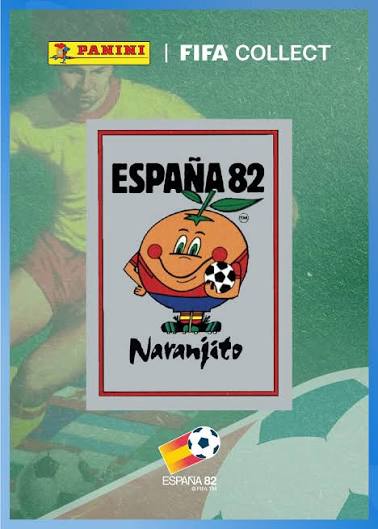
Four years later, the World Cup came to Spain. I still knew almost nothing about FIFA or the machinery that decides where a tournament will be held. I knew only the excitement of welcoming the world, of seeing the best players come to our country, of realizing that familiar stadiums had become part of a global map. I remember Naranjito, the cheerful orange mascot wearing Spain’s kit. We have many oranges in Spain, so the joke required no explanation. He was bright, local, charming, and impossible for a child not to love.
Most of all, I remember the cromos: the collectible Panini stickers sold in small packets, each one carrying a player, a team emblem, or a stadium toward the promise of a completed album. “Cromos” is not quite the word in English. They were stickers, but that ordinary word does not contain the whole ritual—the unopened packet, the quick scan for a missing number, the duplicates, the trades, the empty rectangles waiting to be filled. I collected every one. I still have the complete album today, properly stored, with the teams and the host stadiums exactly where they belong.
That album may be the most honest archive I own. It does not tell me what FIFA executives discussed or what governments expected in return. It preserves the scale on which a child experienced the tournament: one packet, one player, one blank space at a time. The politics existed; my innocence existed too. Paper has held both truths for more than forty years.
Maradona and the Golden Age of Innocence
Then came Mexico in 1986, glorious for many reasons and complicated by almost everything we have learned since. The new remarkable Netflix film Mexico 86 is not a documentary, although it borrows from a remarkable true history. It is a satirical dramatization about how Mexico secured the tournament after Colombia withdrew, turning bureaucratic improvisation, national ambition, and the absurd theater of dealing with FIFA into comedy. The film exaggerates and invents, as satire does, but its central instinct feels accurate: the public sees the ceremony of a host announcement; behind it lies a contest of influence, persuasion, vanity, money, and sometimes corruption.
For me, however, Mexico 1986 will always belong first to Diego Armando Maradona. He had played for FC Barcelona, unfortunately for too short a time. Memory has its own exchange rate, and over the years I translated his transfer into a surprisingly small modern figure. The historical record is clearer: Barcelona paid roughly £5 million in 1982, a world-record fee at the time. Even that sounds tiny beside today’s transfer market, but he was already understood to be a player beyond ordinary valuation.
Barcelona never received the full Maradona story. Illness and terrible injuries interrupted him, including the savage ankle fracture caused by Andoni Goikoetxea. By Maradona’s own later account, cocaine also entered his life during those Barcelona years. He left for Napoli in 1984 and transformed what had been a proud but unsuccessful southern club into a champion of Italy and a power in Europe. He did more than improve a team. He altered the emotional hierarchy of a country in which the wealthy north had long treated the south with contempt. Naples did not merely support him; it recognized itself in him—brilliant, excessive, mocked by the powerful, and unwilling to remain in its assigned place.
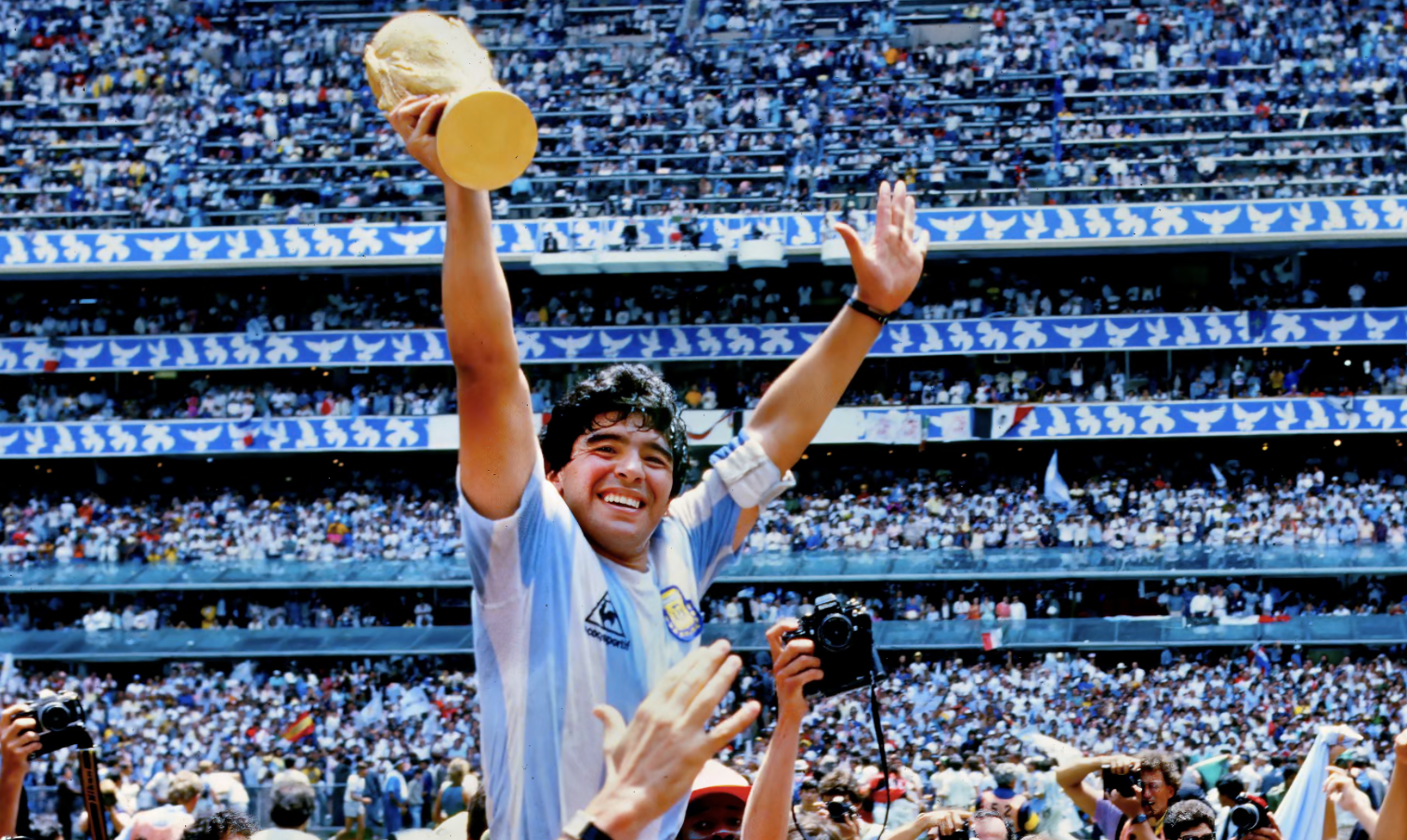
At the 1986 World Cup, all of Maradona’s contradictions became visible in a single match. Against England in the quarterfinal, he scored with his hand and then, four minutes later, scored perhaps the most beautiful goal in World Cup history, carrying the ball through a defense and around the goalkeeper as though the laws of balance had been revised for him alone. The “Hand of God” and the Goal of the Century belong together. One was deception; the other was genius. To separate them would make the story morally simpler and humanly less true.
Maradona dominated the tournament and lifted the trophy. For me, he was the greatest player ever to touch a football until Lionel Messi completed his own story by winning the World Cup in Qatar in 2022. That judgment is personal, not mathematical. Greatness includes statistics, but it also includes the scale of what a player makes you believe is possible. Maradona seemed able to carry a team, a city, a country, and all his private chaos inside the same left foot.
I think of the World Cups from 1978 through 1986 as my golden era, not because every match was better or every institution more honorable, but because I was still innocent enough to receive them whole. That innocence could not last. For years I filed one painful image under the 1990 tournament: Maradona running toward a camera after scoring, his eyes unnaturally wide, his celebration almost frightening. The record corrects my memory. It happened in 1994, against Greece, shortly before he was expelled from the World Cup after testing positive for ephedrine. What I remember most accurately is the sadness. A hero’s addiction did not make me feel superior to him; it made me feel that something enormous was being lost in public.
Maradona fought with the Argentine federation and with FIFA, and in 1995 he helped launch an international players’ union intended to counterbalance football’s governing powers. None of this made him a saint, and he never needed another mythology. At his farewell match in 2001, he offered a sentence that contained accountability and defiance: “I made mistakes and I paid for them, but the ball is not stained.” In Spanish, the final clause is unforgettable: la pelota no se mancha. He was speaking about his own life, but the sentence has become a test for the entire sport.
A Way of Seeing the Field
If Maradona changed what I believed one player could do, Johan Cruyff changed what I believed a team could understand. On May 20, 1992, FC Barcelona defeated Sampdoria 1–0 at Wembley to win our first European Cup. The match reached extra time before Ronald Koeman drove a free kick into the net. One goal, one trophy, one release of decades of longing. Yet the deepest legacy of that night was not the score. It was the vindication of a way of playing.
Cruyff’s Barcelona became known as the Dream Team, a name that lived in the same Barcelona summer as the original American basketball Dream Team of Michael Jordan, Magic Johnson, Larry Bird, and company at the 1992 Olympic Games. The basketball team overwhelmed opponents with a concentration of individual talent the world had never seen. Cruyff’s football team demonstrated something slightly different: talent made more powerful by an organizing idea. The players had freedom because the structure gave their freedom meaning.
For much of the preceding era, the Italian tradition of catenaccio had made defensive security the dominant image of tactical seriousness: close spaces, protect the goal, counterattack, make the opponent suffer for every opening. Cruyff did not abolish defending, and modern football never abandoned the value of a clean sheet. He changed the location and method of defense. Keep the ball and the opponent cannot score. Move the ball into the opponent’s half and the danger is farther from your goal. Widen the field when you have possession; compress it when you lose possession. Create triangles, offer passing angles, exchange positions, press immediately, and make the other team chase shadows.
This sounds obvious after decades of imitation, which is how revolutionary ideas often end. But it demanded courage. Possession was not decoration or a contest to see who could accumulate the prettiest statistic. It was territorial control, energy management, and collective intelligence. If the ball can do the running, your players do not have to. If the opponent must keep turning, chasing, and deciding, fatigue becomes tactical pressure. Cruyff taught Barcelona to defend by thinking ahead.
Pep Guardiola absorbed that education as a player and later refined it as a coach. His teams added ferocious counterpressing, positional precision, and new solutions to the same old question: how can eleven players make the field feel enormous to themselves and tiny to everyone else? The ideas moved beyond Barcelona. Coaches adapted them, opponents built systems to resist them, and Spain’s national team benefited from a generation for whom positional football had become almost a native language.
The sequence is now part of football history: Spain won the European Championship in 2008, the World Cup in 2010, and the European Championship again in 2012. The country returned to the continental summit in 2024 and, in 2026, became world champion again. This was not a continuous reign; football never grants one. Spain suffered painful exits and periods of sterile possession. The game learned how to press the pressers. Direct play returned in new forms. But the intellectual inheritance remained visible—in the comfort under pressure, the angles around the ball, the insistence that technical players could also defend aggressively.
In 2010, Iniesta scored against the Netherlands in the 116th minute. In 2026, Ferran Torres scored against Argentina in the 106th. Two extra-time goals, sixteen years apart, gave Spain its first and second stars. The newest team was not a museum exhibit devoted to 2010. It was quicker, more vertical when the moment demanded it, and defensively extraordinary. Spain conceded only one goal across eight matches in the expanded tournament. The Cruyff DNA had not been preserved in amber; it had evolved.
That evolution makes comparisons between eras irresistible and impossible. It is tempting to say that almost any team from the 2026 World Cup—with its conditioning, video analysis, pressing schemes, nutrition, substitutions, and carefully trained restarts—would be a formidable opponent for Argentina or the Netherlands in 1978. Of course it would. But Kempes and his contemporaries, born into today’s systems, would also be different players. We cannot drop one era unchanged into another and call the result objective. What we can say is that the field has become faster, the distances between lines smaller, the physical demands greater, and the collective choreography far more elaborate. The ball is the same size. Almost everything around it has accelerated.
The World Inside the Game
Goldblatt is not the only writer who has helped me understand why football explains so much beyond football. Franklin Foer’s How Soccer Explains the World uses clubs and rivalries to examine globalization. Its argument is deliberately paradoxical. Global markets, television, migration, and capital connect the game more tightly than ever, but connection does not dissolve local identity. It can intensify tribal loyalties, revive old hatreds, and give corrupt elites new tools. A club may be a global brand and still carry the politics of a neighborhood, a religious divide, or a national wound. Globalization makes the sport larger; it does not automatically make the people around it wiser.
Simon Kuper and Stefan Szymanski’s Soccernomics attacks the game’s favorite clichés with data. It asks why certain countries overperform, why clubs repeatedly make irrational decisions in the transfer market, what wages reveal about success, how networks of football knowledge spread, and whether hosting major tournaments produces the economic miracles promised in advance. Its method is useful because football culture can become allergic to evidence. We love stories about destiny and national character. The numbers often reveal systems: population, wealth, experience, access, recruitment, and the efficiency with which institutions turn human possibility into development.
That helps answer a question Americans often ask: why is the United States men’s team not better? The premise needs care. The United States is not bad at football. It qualifies regularly, produces elite players, has a rapidly improving professional structure, and reached the round of 16 in 2026 before losing to Belgium. The real question is why a country so large, wealthy, and athletically successful has not yet become a consistent men’s contender.
There is no single answer, and “the best athletes choose other sports” is not enough. Football greatness does not emerge merely from an inventory of fast bodies. It requires an ecosystem. In many football countries, children encounter the game informally, cheaply, and constantly. In the United States, elite youth soccer has too often been organized through expensive travel teams and a pay-to-play structure that filters opportunity through family income. Development is fragmented across schools, clubs, academies, colleges, private coaches, and competing governing interests. Talented players can be found late or asked to spend too much time proving they can afford the path.
The culture is changing. MLS academies, lower-division clubs, better scouting, dual-national players, and stronger links to European football have widened the pipeline. But a national team becomes great when technical education, public access, serious coaching, competitive games, and a lived relationship with the sport reinforce one another for years. Mauricio Pochettino has spoken about the need for a deeper emotional relationship with football in the United States. That phrase matters. Facilities can be built. Culture has to be inhabited.
The 2026 World Cup showed the opportunity and the contradiction at enormous scale. The 39-day tournament began with Mexico against South Africa on June 11; the United States opened against Paraguay the following day. Forty-eight teams played 104 matches across three countries. Existing NFL and multipurpose stadiums limited the need for the white-elephant construction seen at some past tournaments, but “Is hosting worth it?” still has no universal answer.
For FIFA, the answer is usually yes. The organization captures broadcasting, sponsorship, ticketing, and commercial value on a global scale. For a host city, the ledger is more complicated. Visitors spend money, workers are hired, public spaces fill, and a place receives international attention that cannot be purchased in the ordinary way. At the same time, local governments and organizing committees absorb security, transport, temporary facilities, stadium modifications, fan festivals, and opportunity costs. Economic-impact studies often count optimistic benefits while treating public risk as background. The final answer depends on what infrastructure already exists, who pays, who receives the revenue, what remains after the cameras leave, and whether citizens were told the truth before the agreement was signed.
Not everything valuable appears in gross domestic product. Spain 1982 gave me an album I still own and a memory I would never volunteer to surrender. A host nation may gain civic energy, shared experience, and a generation of children newly attached to the game. Those things are real. They are not excuses for secret contracts or inflated forecasts. Memory belongs on the benefit side of the ledger; honesty belongs on both sides.
The money concentrated in club football offers another view of the sport’s global scale. According to Forbes’ 2026 valuations, the ten most valuable clubs were:
| Rank**** | Club**** | Estimated value**** |
| 1 | Real Madrid | $9.5 billion |
| 2 | FC Barcelona | $7.5 billion |
| 3 | Manchester United | $7.2 billion |
| 4 | Liverpool | $6.2 billion |
| 5 | Paris Saint-Germain | $5.8 billion |
| 6 | Bayern Munich | $5.7 billion |
| 7 | Manchester City | $5.5 billion |
| 8 | Arsenal | $5.4 billion |
| 9 | Chelsea | $4.2 billion |
| 10 | Tottenham Hotspur | $3.0 billion |
The list is fascinating, and as a Barcelona supporter I cannot pretend to be emotionally neutral about the order. But value is not virtue. A valuation measures revenue, commercial reach, assets, expectations, and scarcity; it does not measure beauty, courage, community service, or what a club means to a grandparent and child entering a stadium together. Modern football is simultaneously a cultural inheritance and an investable asset. The danger begins when the second reality is allowed to consume the first.
The Institution Above the Game
The 1440 documentary The Rise of Soccer and the Fall of FIFA tells the institutional story in compressed form: how a small organization founded by European associations grew alongside the World Cup into one of the most powerful bodies in global culture, and how that concentration of money and discretion created ideal conditions for corruption. Netflix’s four-part FIFA Uncovered goes deeper into the host-selection system, political alliances, patronage networks, and criminal investigation that culminated in the 2015 arrests in Zurich.
The United States Department of Justice charged FIFA officials and sports-marketing executives with racketeering, wire fraud, and money laundering conspiracies tied to more than two decades of bribery and kickbacks. The case did not prove that every person in football governance was corrupt, nor did every public allegation end in a conviction. It did something more important than feed a slogan: it exposed structural incentives. A small electorate, enormous commercial rights, opaque decisions, and weak external accountability had turned favors into a governing language.
Sepp Blatter’s presidency became the emblem of that system. He was extraordinarily skilled at building electoral loyalty and presenting FIFA as a humanitarian force while scandals accumulated around the organization. I find that record despicable. The word is strong because the betrayal was strong. Football’s administrators receive their authority from a game they did not invent and a public devotion they did not create. To convert that borrowed authority into private advantage is not clever politics. It is theft from trust.
Gianni Infantino’s FIFA promised reform, yet the panorama today is hardly reassuring. In 2026, FIFA inserted mandatory three-minute hydration breaks around the twenty-second minute of each half, regardless of the conditions. FIFA described the pauses as a player-welfare measure. Players, coaches, and viewers objected that the universal rule disrupted rhythm and made football feel divided into four quarters. Critics also saw something FIFA could not plausibly fail to notice: a predictable pause is predictable commercial inventory. Player welfare is not a trivial concern in summer heat. The honest question is why the rule ignored temperature and match conditions, and why a safety intervention aligned so neatly with advertising opportunity.
The controversy surrounding United States forward Folarin Balogun was worse because it struck at competitive independence. After Balogun received a red card, President Donald Trump personally asked Infantino to review the decision. FIFA’s disciplinary committee later suspended the resulting one-match ban for a year, allowing Balogun to play against Belgium. FIFA insisted that its disciplinary process was independent. Even if one accepts the formal distinction between the president and the committee, the sequence fails the appearance-of-independence test. A national president called the head of the governing body; the sanction affecting that president’s team changed. Football cannot ask players to respect the referee while teaching powerful governments that a private appeal may open another door.
Infantino’s closeness to political power—including FIFA’s decision to present its inaugural peace prize to Trump—has generated complaints that the organization abandoned its own requirement of political neutrality. The problem is larger than one politician or one call. FIFA must cooperate with governments to stage a World Cup, but cooperation is not courtship, and diplomacy is not personal allegiance. The president of FIFA should protect the game’s credibility most fiercely when proximity to power makes that protection uncomfortable.
There are many more episodes I could list, and eventually the list itself becomes a form of vertical fatigue: scandal under scandal until the reader feels only resignation. That is another danger. Corruption can become so familiar that outrage turns into atmosphere. We begin to treat the dirty part of the game as weather—unfortunate, permanent, and beyond the responsibility of any individual.
I found a better answer to that resignation in Eduardo Galeano’s El fútbol a sol y sombra—published in English as Football in Sun and Shadow, a book I read and loved deeply. Galeano called himself a “mendigo del buen fútbol,” a beggar for good football, and wrote with the gratitude of someone still astonished by the game’s beauty. His loyalties remained with the audacious dribble, the unlikely goal, the suffering goalkeeper, and the supporters, never with officials who turned their passion into commerce or the World Cup into an instrument of power. He exposed the business and corruption around football without allowing them to become the whole story. That is the position I recognize: neither innocence nor cynicism, but the vigilance of someone who refuses to let business consume the beauty that made it possible.
The one and only Bob Costas once described the tension of covering the Olympics with unusual honesty. He acknowledged the hype, hypocrisy, corruption, and controversy, but insisted that the competition still contains “legitimate drama, extraordinary excellence, and honest human emotion.” I understand that choice. I make a version of it with FIFA. I watch because I love the players, the tactics, the supporters, the songs, the impossible saves, and the pass that nobody else saw. I will not surrender those things to an executive committee.
But attention to the athletes cannot require silence about the institution. The choice is not innocence or cynicism, as though adulthood must pick one. We can recognize the spectacle and inspect its financing. We can celebrate a host city and ask who paid. We can admire a champion and oppose the political use of the trophy. We can love football enough to demand that the people who govern it behave as custodians rather than owners.
Nobody Gets There Alone
A short documentary series from New York Life, The Assist, explores one of football’s deepest truths: no one gets there alone. The sport loves the image of the solitary genius—the dribble through five defenders, the free kick that changes a final, the goalkeeper’s hand appearing from nowhere—but even genius arrives through a network. Someone opened the field. Someone made the decoy run. Someone coached the first touch, washed the kit, drove to training, maintained the pitch, accepted a place on the bench, or kept believing after an injury. A goal may carry one name in the record. Its history is plural.
That is why football can educate a society, especially its children, although it does not do so automatically. Sport can teach effort, discipline, patience, courage, cooperation, resilience, and a growth mindset—the understanding that ability can be developed through deliberate work. It can teach a child to follow rules when breaking them might be advantageous, to control anger when a decision feels unfair, to accept correction, to recognize an opponent’s excellence, and to lose without humiliation. It can teach a winner not to confuse victory with superiority.
These lessons require adults and institutions willing to model them. A youth match full of screaming parents does not teach respect simply because a ball is present. A federation does not promote fair play by printing the words on a banner while rewarding political influence in private. Values become real through repetition: shake the opponent’s hand, help a player up, arrive prepared, tell the truth about the touch that sent the ball out, apologize for the dangerous tackle, thank the teammate whose unnoticed run created your goal.
Children look up to players just as I did nearly fifty years ago. They copy the boots, celebrations, haircuts, gestures, and ways of speaking. That visibility is a privilege and a burden. When Maradona struggled with drugs, many of us were deeply sad because his gifts had entered our imaginations before his problems entered our understanding. His failures were real. So was his attempt, in that farewell speech, to separate the damage he had done to himself from the game that had given him and us so much.
I return at last to my 1982 album. The little rectangles are full. Naranjito is still smiling. The stadiums remain fixed on the page even though some have changed, sponsors have changed, players have aged, governments have fallen, and FIFA presidents have come and gone. The object is fragile, but its meaning has proved durable. It reminds me that football’s true continuity is not institutional. It is the passage of attention: a child learns the names, an adult learns the history, and neither has to destroy the other.
The 2026 final gave me Spain against Argentina and returned me, unexpectedly, to Argentina against the Netherlands in 1978. Between those matches I lost the innocence that once allowed the World Cup to arrive without politics. I gained something better: a love capable of seeing the whole field. I can see the dictatorship behind the celebration, the money behind the host selection, the commercial opportunity inside the hydration break, and the dangerous phone call behind a disciplinary reversal. I can also see Kempes, Maradona, Cruyff, Koeman, Iniesta, Messi, Ferran Torres, and millions of unnamed players making one another better.
FIFA’s dirty politics are despicable because football is worth more than the uses to which they put it. The corruption is not evidence that our love was foolish. It is evidence that our trust requires defense. The institution can be disgraced; the game must be protected. That is what I now hear in Maradona’s imperfect, necessary sentence: la pelota no se mancha.
© Francesc Borrull, 2026
P.S. Reading and Viewing the Wider Game
For the broad historical frame, begin with David Goldblatt’s The Ball Is Round, then read Franklin Foer’s How Soccer Explains the World and Simon Kuper and Stefan Szymanski’s Soccernomics. Eduardo Galeano’s El fútbol a sol y sombra belongs beside them as the literary and emotional counterweight: a history of the game written from inside its beauty, sorrow, politics, and contradictions.
For the politics of FIFA, watch Netflix’s FIFA Uncovered and 1440’s The Rise of Soccer and the Fall of FIFA. For a comic dramatization of the maneuvering around a host bid, watch Mexico 86, keeping in mind that it is satire inspired by history, not a documentary record.
The factual scaffolding for this essay also includes FIFA’s account of Argentina 1978, Amnesty International’s contemporary reporting on Argentina’s dictatorship, FC Barcelona’s history of Wembley 1992, the United States Department of Justice’s 2015 FIFA indictment announcement, and reporting from Reuters on Spain’s 2026 final victory, ESPN on the hydration-break controversy, and Reuters on the ethics dispute following the Balogun decision.
For the economics and development questions, see NC State’s review of World Cup impact claims, ProPublica’s reporting on the obligations carried by American host cities, and Reuters on the shortcomings of the projected economic boost in Mexico.
 Francesc Borrull