
By Francesc Borrull · October 5, 2026
An Open Door
During a recent stay in the St. Louis area, I set aside time for the Mildred Lane Kemper Art Museum at Washington University. I had already been impressed by the university’s Danforth Campus: the care given to its buildings and grounds, the sense that architecture could create not only useful space but a state of attention. The museum intensified that impression. Its geometry is disciplined without being cold; the building seems confident enough not to compete with the art it contains. Before I had looked closely at a single painting, I was already inside the question that would follow me through the galleries: what can wealth build, preserve, and make available to others?
The Kemper belongs to a long institutional history. Founded in 1881, it is one of the oldest teaching museums in the United States; its collection now includes approximately 8,700 works. The current building, designed by Fumihiko Maki and opened in 2006, was expanded in 2019 by KieranTimberlake, more than doubling the space devoted to the permanent collection. Those details matter because a museum is never only a room in which objects happen to hang. It is architecture, endowment, scholarship, conservation, administration, and accumulated human judgment. All of that can sound forbiddingly institutional—until one reaches the fact that changed the moral atmosphere of my visit: admission is free.
When I later tried to explain my enthusiasm to my wife, my first formulation was much less measured than anything I would use in an art-history seminar. “They are filthy rich,” I said, “but they have the sensibility to acquire beauty and the moral compass to share it with the public.” The sentence was blunt, and as institutional history it was incomplete. Museums are created through a web of collectors, donors, acquisition funds, curators, conservators, scholars, architects, and universities; the motives gathered inside that web are rarely pure or simple. Yet my unpolished sentence caught something I did not want a more refined vocabulary to conceal: gratitude.
Money can purchase an artwork and an institution can preserve it, but public access releases it from the narrow meaning of possession and gives it a civic life.
That civic life does not mean that ownership disappears. The Kemper still owns what it has bought or received, and works of art remain material objects with insurance values, provenance records, storage requirements, and legal custodians. What changes is the range of people to whom the work can matter. Once the doors open, possession becomes porous. A painting acquired by means unavailable to almost everyone can enter the memory of anyone who walks in: a student between classes, a resident of St. Louis, a traveler, a child, a scholar, or simply a person willing to look.
Four Encounters
The four works that first organized the visit for me came from two Spanish artists, Pablo Picasso and Juan Gris, and two Catalan artists, Joan Miró and Antoni Tàpies. They did not form a single school or belong to a single historical moment, and I did not encounter them as four representatives lined up to illustrate an art-history survey. They arrived one by one, each asserting its own presence and asking for a different kind of attention, yet together they sharpened the question I had brought into the museum: what happens to a work of art when private possession becomes public encounter?
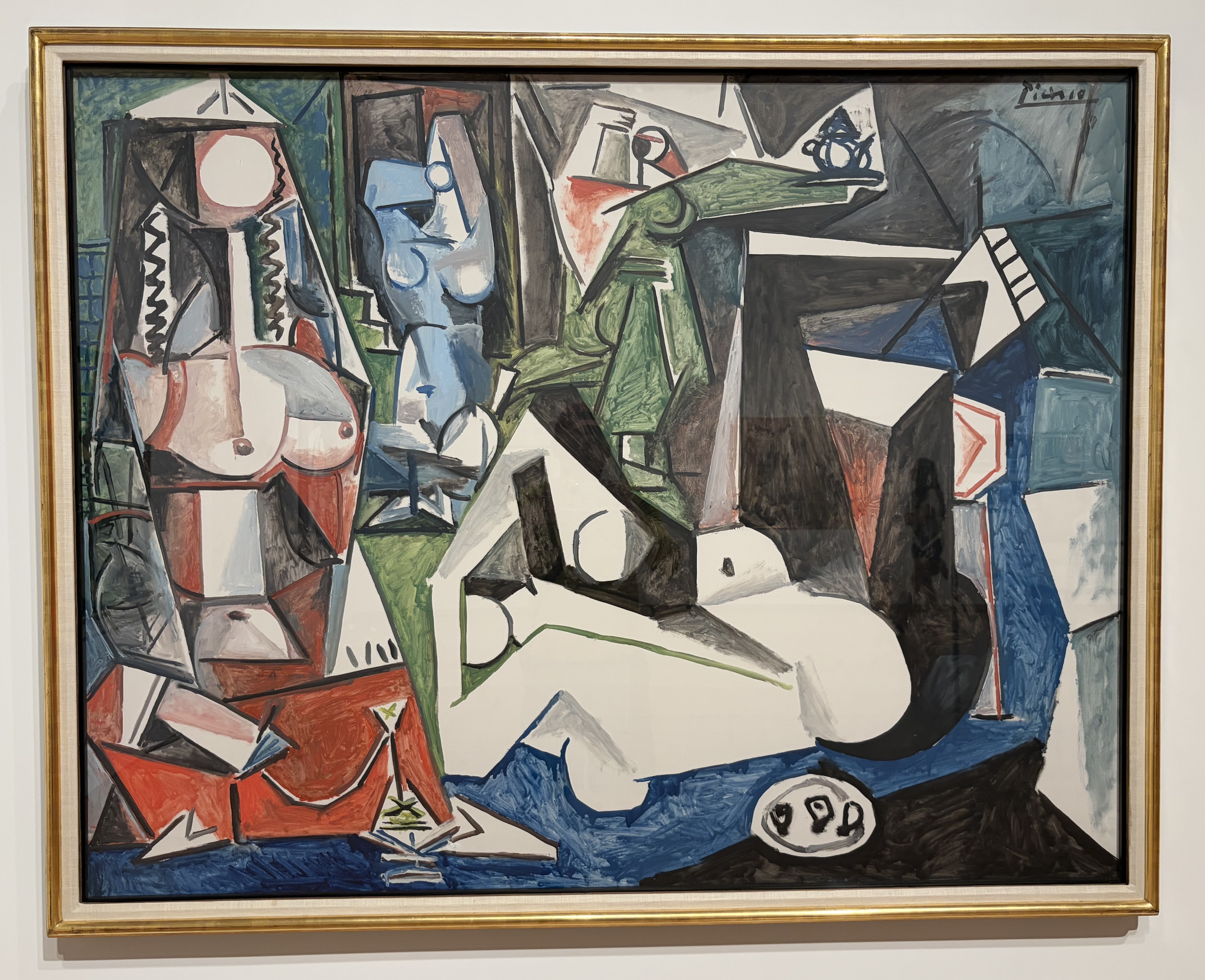
Picasso’s Les femmes d’Alger (Women of Algiers), Variation N is the second-to-last of fifteen paintings he made in 1954 and 1955 in response to Eugène Delacroix’s nineteenth-century scenes of women in Algiers. Picasso retained the crowded interior and the grouping of bodies, but subjected them to the angular compression of his own visual language. The women do not dissolve into decoration or languid atmosphere. They occupy the painting. Forms collide, faces turn into structures, and the whole room feels less like an invitation to look at passive bodies than a contest over who controls the act of looking. The Kemper’s account emphasizes this movement from Orientalist fantasy toward female confidence and self-possession. That last word stayed with me. Here was a painting about figures who resist passive possession, itself acquired in 1960 through the university’s Steinberg Fund and now placed before a public that does not need permission from a private owner to see it.
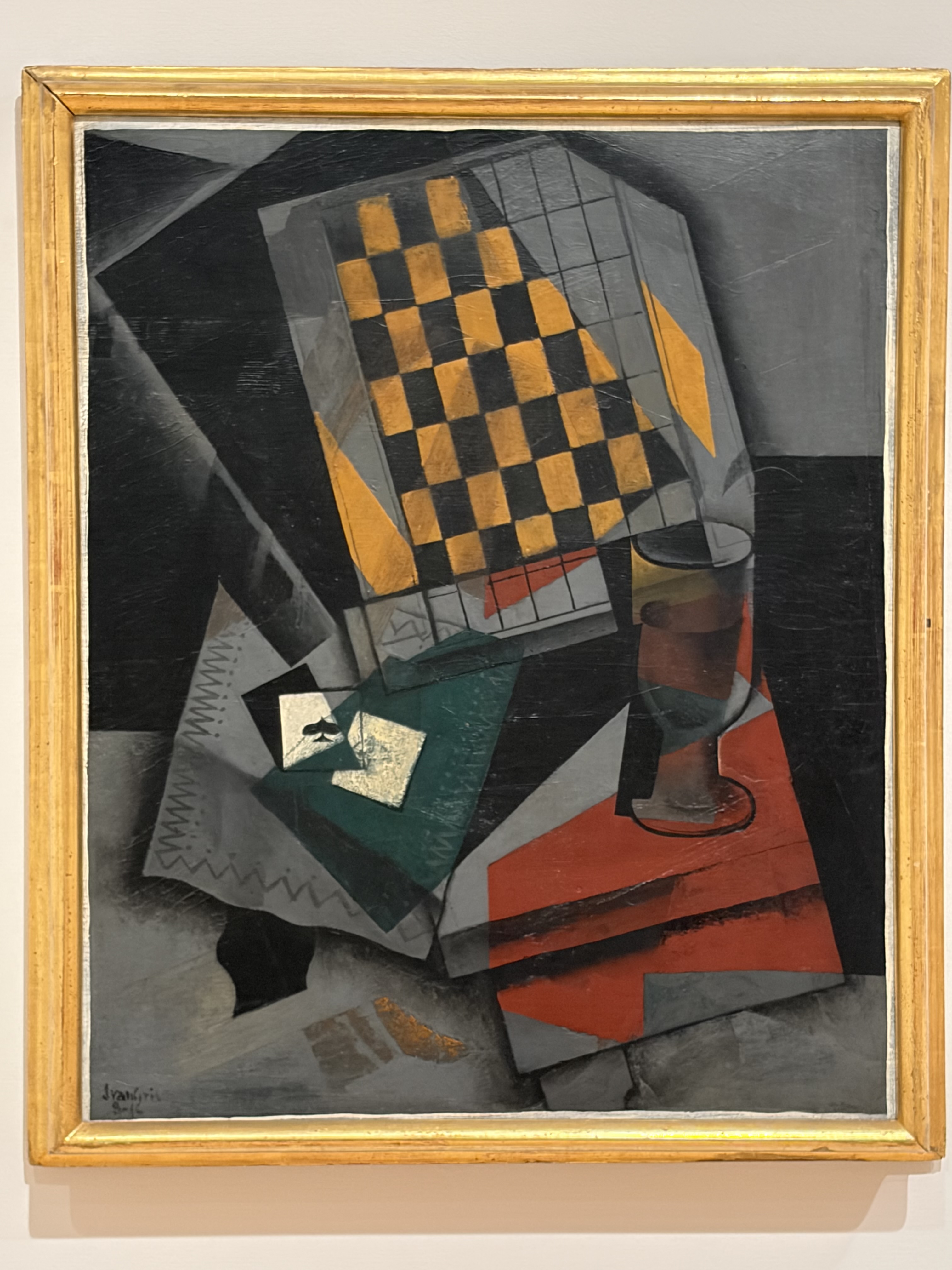
Juan Gris’s Damier et cartes à jouer (Checkerboard and Playing Cards), painted in 1916, works at a quieter frequency. Gris takes familiar objects—a drinking glass, playing cards, a checked surface, the corner of a folded cloth—and rebuilds them as interlocking planes. Transparency and solidity exchange places. One form seems to sit on top of another and then, with a shift in attention, recede beneath it. The pleasure is intellectual without becoming bloodless: perception is made active. Picasso’s fame can dominate any room in which his name appears, but the Gris reminded me that museums do more than confirm the most celebrated reputations. They keep open the possibility of comparison, revision, and rediscovery. Purchased in 1946 through the Kende Sale Fund, the work has spent decades asking successive viewers to slow down and reconstruct a table that never settles into only one view.
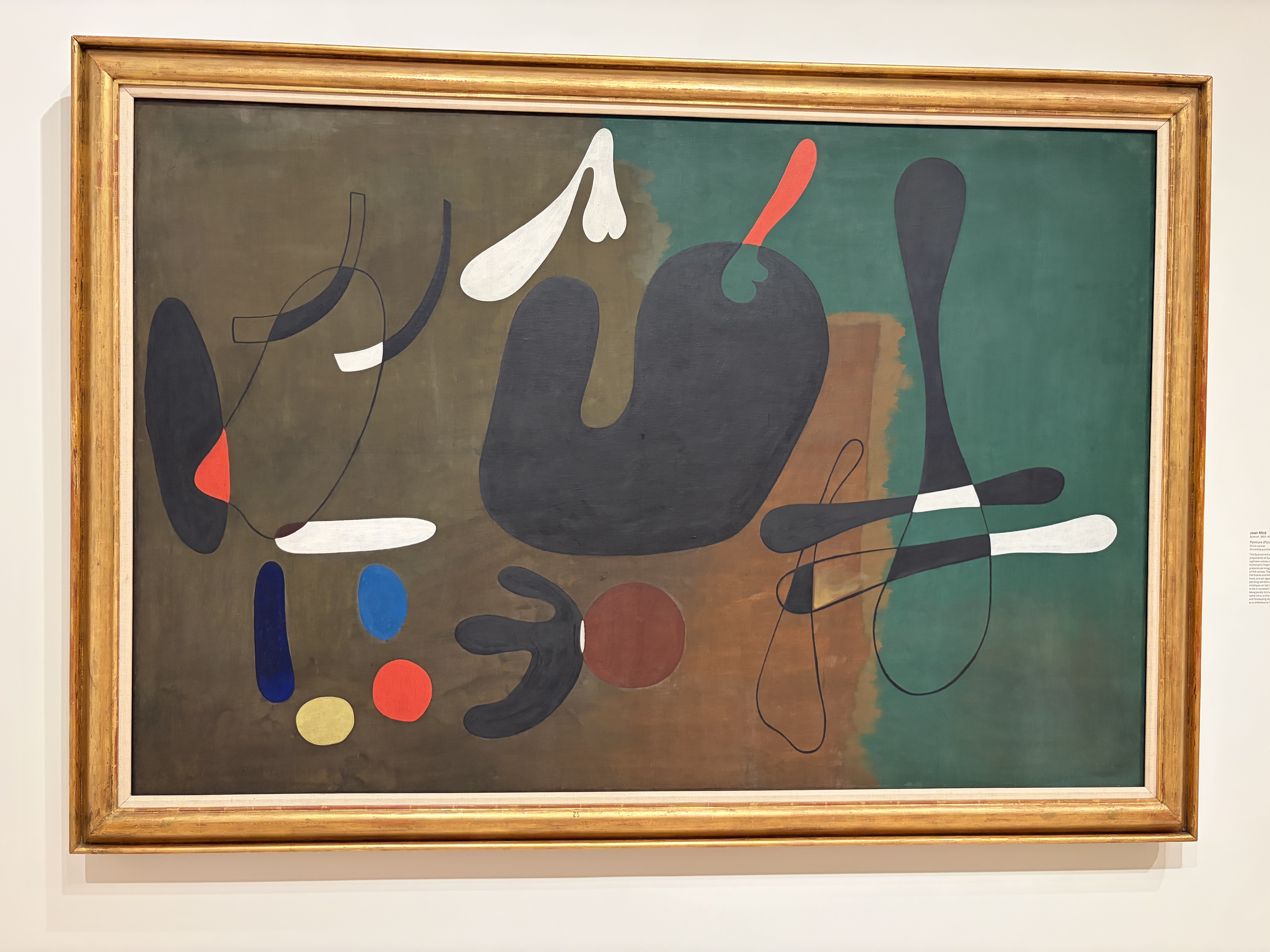
With Joan Miró’s Peinture (Painting) of 1933, the gallery became darker. Miró is often domesticated by familiarity: a few floating signs, bright primary colors, a vocabulary easy to reproduce on posters and souvenirs. This painting refuses that cheerful reduction. It belongs to a group of eighteen compositions that grew from collages made with fragments cut from sales catalogues. On the canvas, biomorphic shapes seem caught between organism and apparatus, growth and threat. Their metamorphosis is playful only at a distance; up close, the atmosphere is unsettled. The museum cautiously places the painting against the violence spreading through Europe in the 1930s and suggests that its dark forms may register the menace of fascism. “May” is important. A painting is not a coded newspaper editorial, and responsible looking should not turn historical context into certainty. Still, the work of this Catalan artist carries the pressure of its moment. Purchased through the Kende Sale Fund in 1945, just after another catastrophe had disclosed the full consequences of fascist power, it now asks viewers to remain with ambiguity rather than escape it.
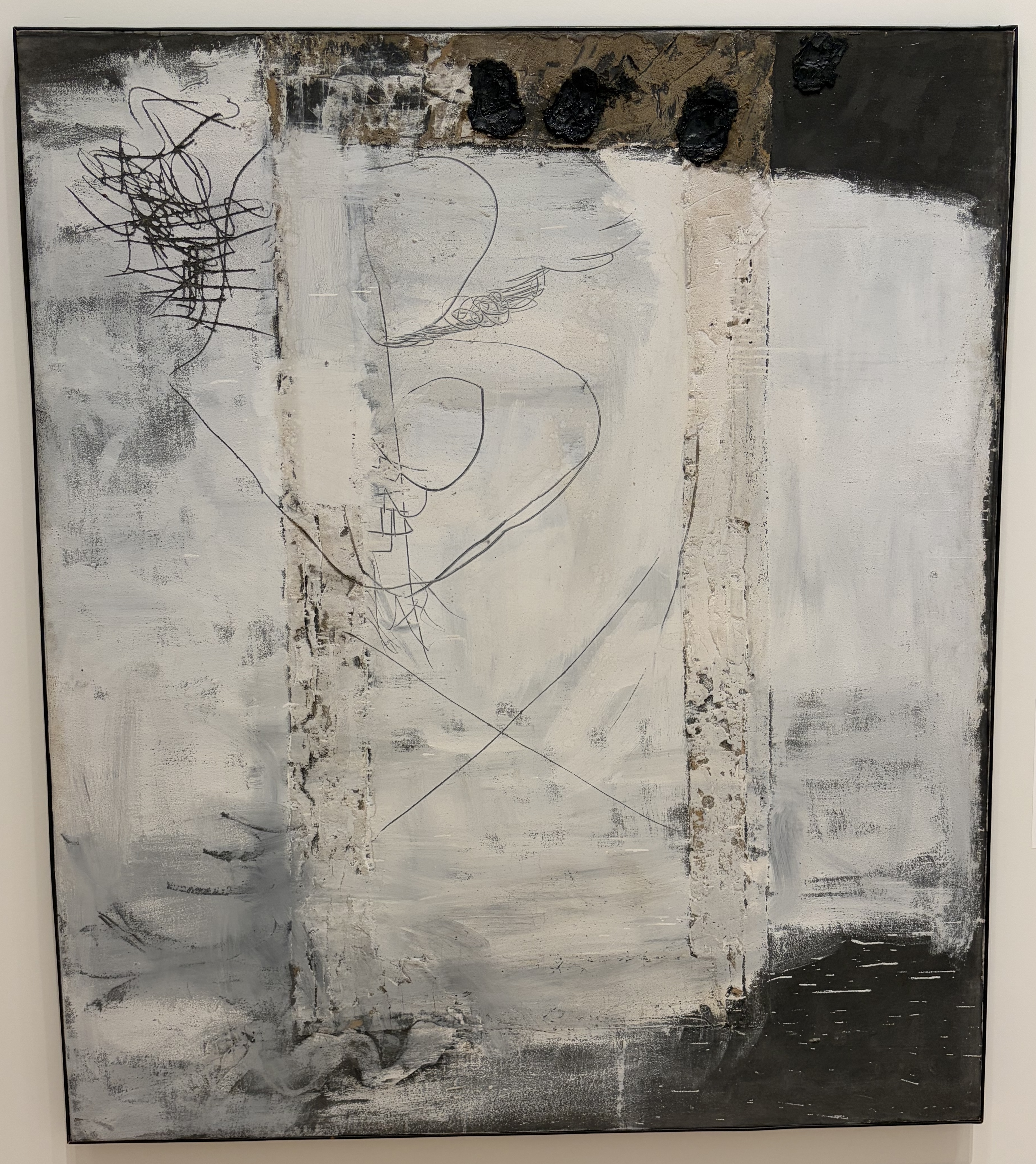
Then I stood before Antoni Tàpies’s Blanco y Grafismos (White with Graphism) from 1957. Sand mixed with oil gives the surface the rough presence of damaged plaster. Marks appear scratched, written, crossed out, or half-buried; the painted field resembles a wall that has absorbed time rather than a window opening onto a scene. Tàpies’s matter paintings found expressive force in substances conventionally considered poor or inert—in dust, earth, abrasion, residue. Under Franco’s dictatorship, the marked wall in Catalonia could also carry the memory of prohibited language and political graffiti. Yet the power of this work is not exhausted by a political key. It feels older than any single regime, close to the primordial impulse to press a sign into a surface and leave evidence that someone was here.
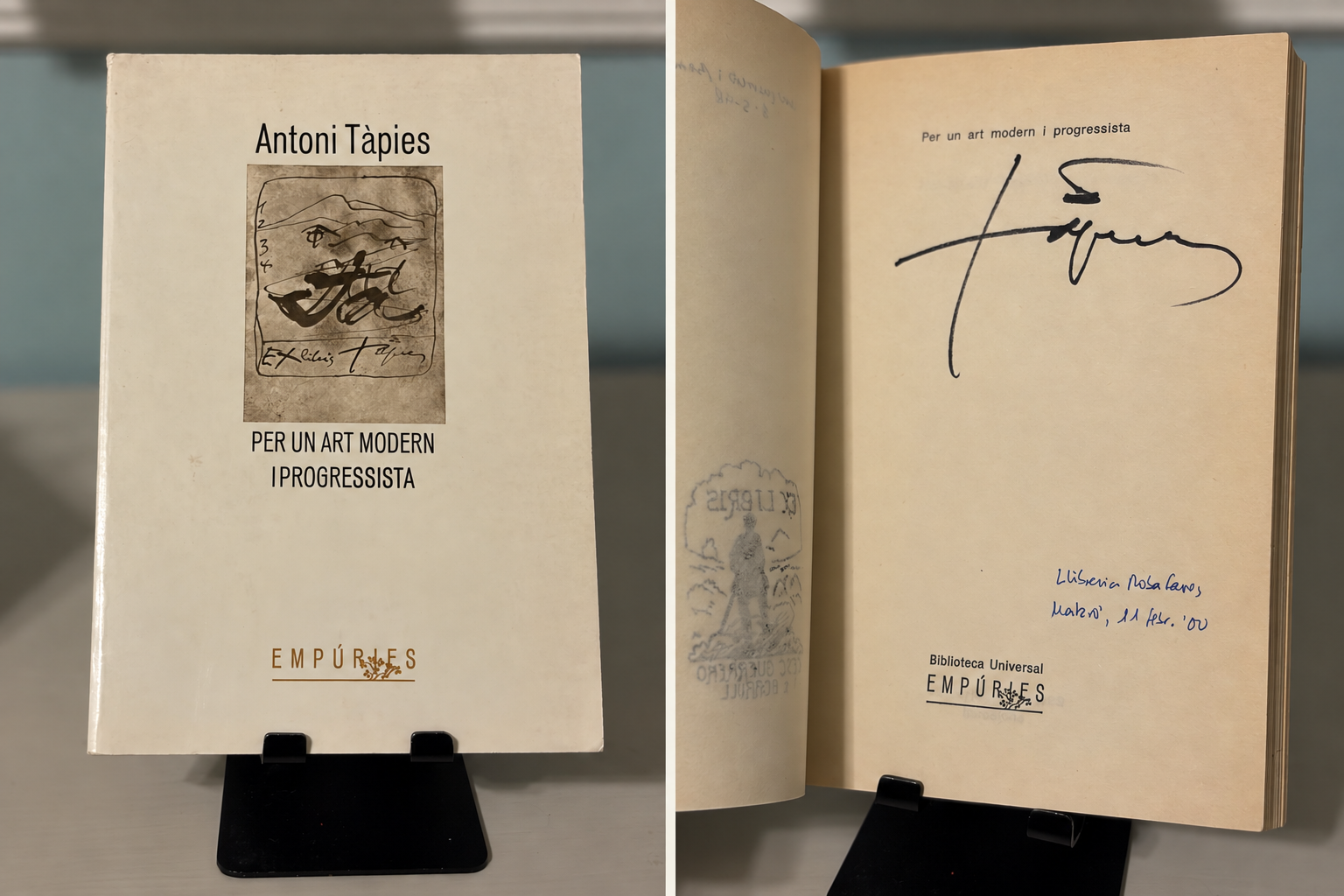
For me, Tàpies could never be only an entry in the history of postwar European art. On February 11, 2000, through people connected with his family, I met him. He signed my copy of Per un art modern i progressista, published by Empúries in Barcelona in 1985, and I wrote the date beneath his signature. We spoke briefly about the book and about questions of art theory. I do not want to inflate a brief encounter into a friendship; its value depends partly on telling it at its true scale. Nevertheless, there are meetings whose brevity does not diminish their permanence. The artist whose surfaces seemed to retain the passage of human bodies and historical violence was suddenly present before me, speaking about what art might be and what it might do.
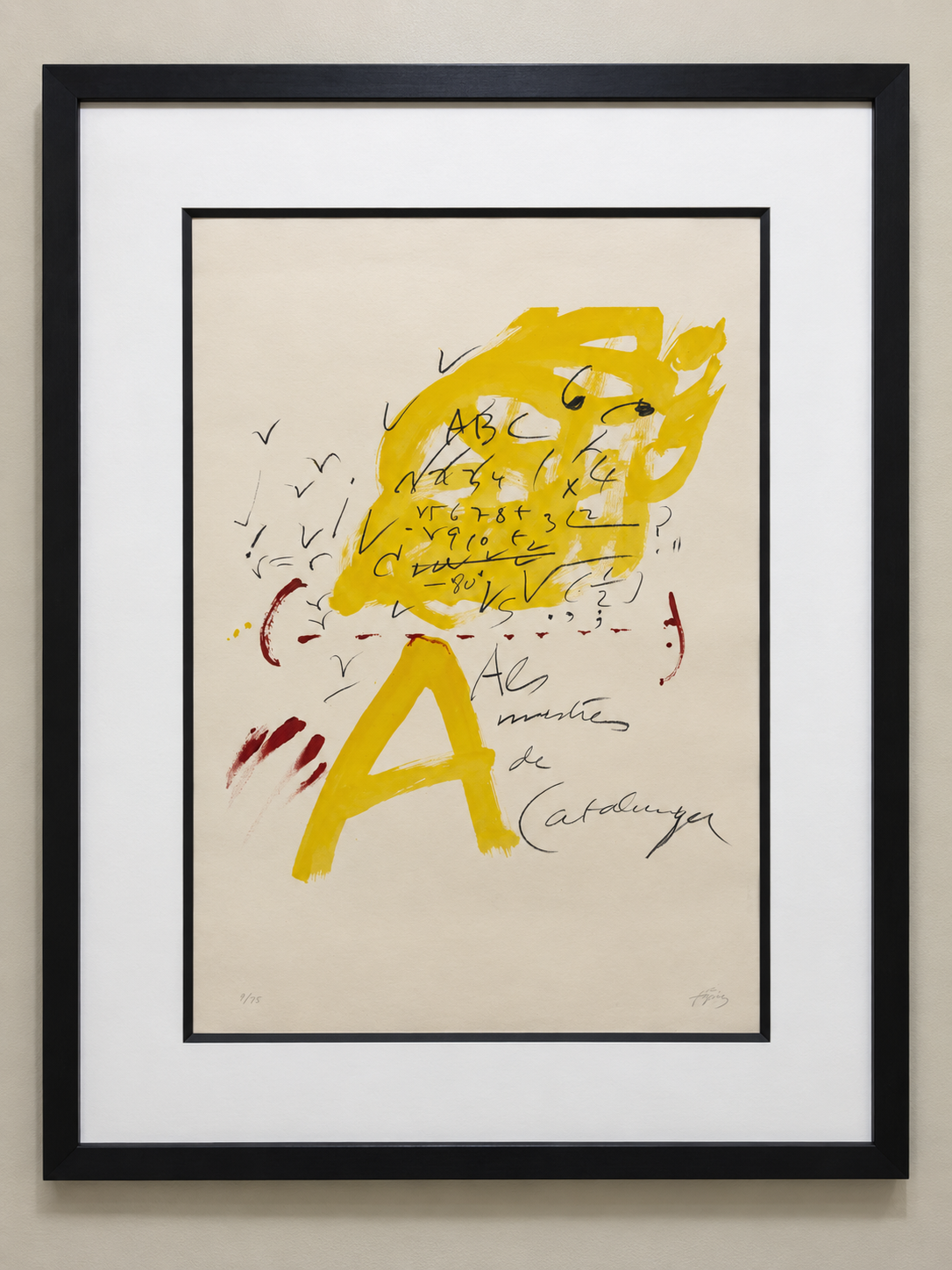
I also own an original Tàpies serigraph from Als mestres de Catalunya, purchased from a gallery in Spain. That fact complicates any easy opposition between private ownership and public virtue. I know the intimate pleasure of living with a work of art: seeing it in different light, passing it on ordinary days, discovering that familiarity does not necessarily exhaust it. Private possession can shelter a sustained relationship. But the painting at the Kemper, a gift from Richard and Florence Weil in 1963, proposed another form of relationship. It returned Tàpies to me far from Catalonia and far from the circumstances of our meeting, while making him equally available to people who had no personal connection with him at all. My signed book preserves the trace of one encounter. My serigraph belongs to the visual life of my home. The museum’s Tàpies enters a common space, where memory can begin for strangers.
The Long Life of an Object
The museum held many other pleasures. Works by Andy Warhol, Paul Klee, and Charline von Heyl widened the conversation beyond the four artists who had become my private constellation for the day. Yet one of the strongest surprises waited in a small room on the lower level, where Ancient Greek ceramics stood with a quiet authority entirely different from the assertiveness of the modern galleries.
I am now in a period of sustained reading and study of Ancient Greek literature. Texts that have survived for more than two millennia can begin to feel uncannily present: old voices enter the room through epic, tragedy, history, or philosophy and speak with an urgency that defeats the category of “the past.” The ceramics produced a related shock. A vase is not an illustration obediently attached to a text. It comes from another system of use, ritual, labor, trade, and looking. But to stand before an object shaped and painted in the world from which those texts emerged is to feel antiquity regain weight, contour, and scale.
I was especially drawn to a Campanian red-figure bell krater attributed to the CA Painter and dated to the middle of the fourth century BCE. I did not need to assign a myth to every figure in order to feel the object’s authority. Its survival was already astonishing. The museum’s history of its Ancient Greek vases notes that it holds thirty vases and fragments; twenty-one entered the collection in 1904 through gifts from Robert Brookings and Charles Parsons, and many had been brought to St. Louis for the Louisiana Purchase Exposition held that year. The history of collecting ancient objects rightly invites questions about excavation, movement, documentation, and ownership. Wonder should not cancel those questions. At the same time, the vessel’s continued existence depends upon generations of stewardship—upon people willing to study it, conserve it, and place it where someone reading Greek literature in the twenty-first century can unexpectedly meet it.
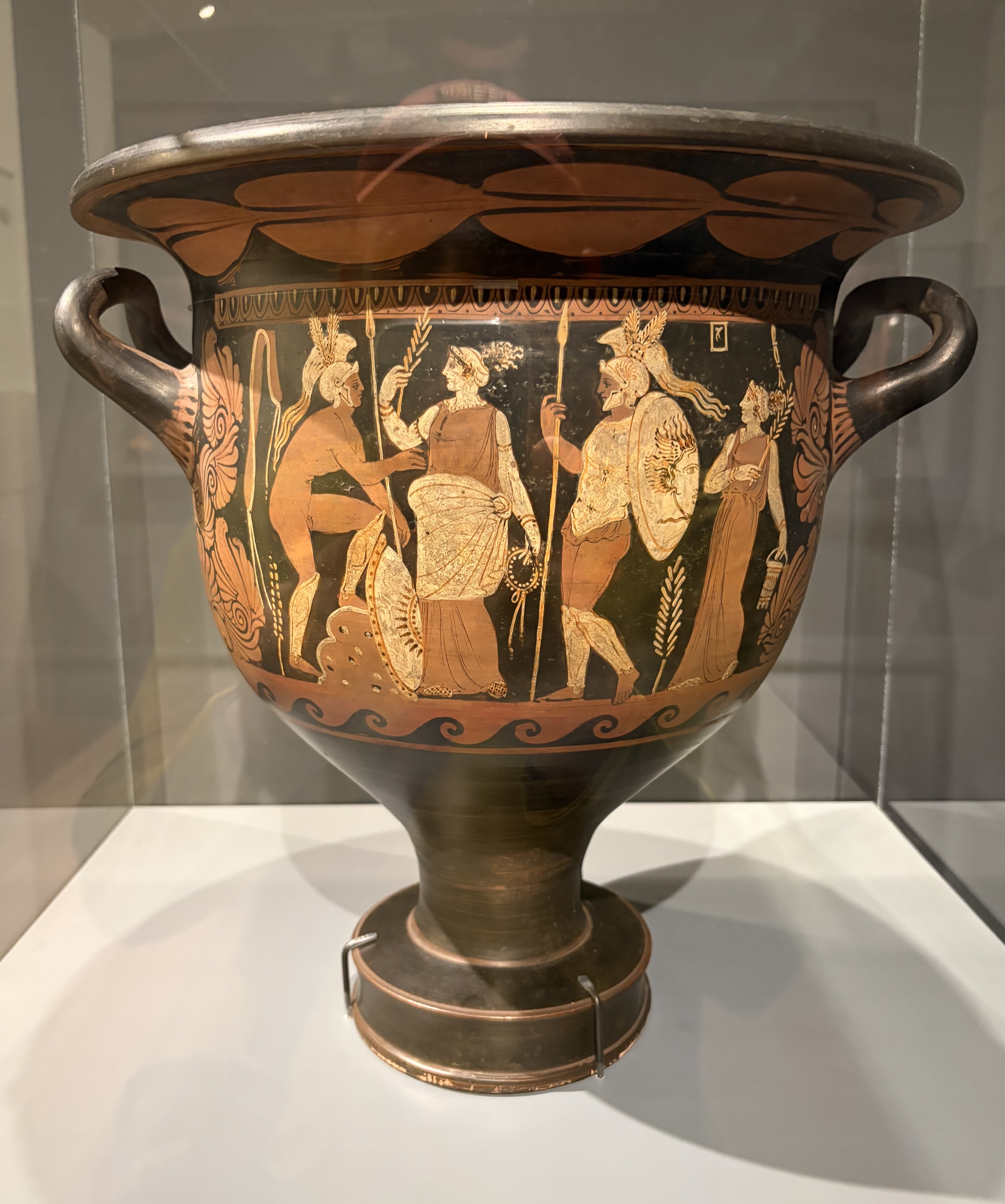
The ancient krater clarified something about the modern paintings upstairs. Art’s civic life is measured not only by the number of people who can enter a gallery today, but also by duration. A collector may possess an object for a lifetime; a responsible institution attempts to carry it beyond any single lifetime. This is not a glamorous task. It involves climate control, cataloguing, repairs, research, and decisions made away from the public eye. Preservation can sound passive, as though the museum merely keeps objects from dying. In practice it is an active promise to the future: someone we cannot know may one day need this work.
What Possession Can Become
It is easy to romanticize patronage, and just as easy to sneer at it. Great fortunes can distort cultural life. The art market can turn judgment into price, convert scarcity into spectacle, and allow wealth to mistake acquisition for discernment. A donor’s name on a building does not settle the moral history of the money that paid for it. Nor does free admission eliminate every barrier. Museums still possess codes of behavior and interpretation that can make newcomers wonder whether they belong.
But suspicion can also become intellectually lazy. The acquisition histories of the four works tell a more complicated story than a millionaire buying a masterpiece and handing it to the public. The Picasso was purchased through one university fund; the Gris and the Miró through another; the Tàpies came as a direct gift. Behind each route lay decisions about what deserved to be kept and made available. Wealth provided the material power, but money alone did not choose wisely, preserve carefully, interpret seriously, or keep the entrance open. The civic achievement lies in the conversion of private resources into continuing public encounter.
That conversion is inseparable from place. The museum’s exquisite architecture did not feel like an empty display of prestige. It helped establish the calm in which attention became possible. After the galleries, I had a simple cappuccino in the very small café and looked through the equally small shop, composed mostly of books. I loved the restraint of both. Nothing felt inflated into an “experience” designed to overpower the art; everything seemed chosen with gusto and kept at a human scale. Coffee, books, architecture, and galleries belonged to one hospitable rhythm. The visit was, quite simply, a ten out of ten—not because every institution must look like this one, but because every element seemed to serve the pleasure of looking and the possibility of learning.
My gratitude is not abstract. I love museums because they make room for a kind of attention that ordinary life often disperses. They permit us to stand still before another person’s act of imagination, then move a few steps and cross decades or civilizations. In one visit I could meet Tàpies again, encounter a more ominous Miró, submit to Gris’s lucid ambiguities, argue silently with Picasso’s transformed harem, and then descend toward the material world of the Greeks I have been reading. None of this required ownership in the domestic sense. It required only time, curiosity, and an open door.
At home, Tàpies remains part of my private life: the signed book with the date beneath his name, the serigraph I chose and bought in Spain. I treasure that form of closeness and would be dishonest to pretend otherwise. Yet the Kemper reminded me that ownership reaches its highest cultural purpose when it becomes answerable to people beyond the owner. A museum does not abolish possession. At its best, it makes possession hospitable.
I left with no object in my hands, but the visit had enlarged what I could remember and what I could love. The works remained behind—bought, donated, catalogued, conserved, and cared for. The doors, however, remained open. That did not cancel ownership. It completed its best possibility.
© Francesc Borrull, 2026
Sources and image references:
- Mildred Lane Kemper Art Museum, The Museum and Visit.
- Mildred Lane Kemper Art Museum collection entries for Pablo Picasso, Les femmes d’Alger (Women of Algiers), Variation N, Juan Gris, Damier et cartes à jouer (Checkerboard and Playing Cards), Joan Miró, Peinture (Painting), and Antoni Tàpies, Blanco y Grafismos (White with Graphism).
- Mildred Lane Kemper Art Museum, A Closer Look at Ancient Greek Vases.

